ASLMU town hall connects candidates to community

Originally published in the Los Angeles Loyolan. For original, please refer to: ASLMU town hall connects candidates to community – Los Angeles Loyolan.

ASLMU

Photo Credit: ASLMU

Amidst the senatorial and presentational debates that took place last week, ASLMU hosted a smaller town hall meeting with all 23 students running for office this election cycle Wednesday night in St. Robert’s Auditorium.

The town hall featured all three presidential-vice presidential tickets and the 17 senatorial candidates answering a mixture of prepared questions and questions from the audience. The recent announcement of higher parking fees was a major topic of conversation, as were the needs for more transparency and the senatorial candidates’ lack of experience and knowledge about their job requirements.

Current Speaker of the senate and senior communication studies major Mary O’Laughlin was the first to reference the latter topic, noting that several of the candidates’ plans for changes if elected were already part of the ASLMU senate’s activities. Several candidates didn’t answer the question, while others, like sophomore accounting major Michael Curran, owned up to their lack of knowledge while pledging to do their research. After a few of the candidates’ responses, junior marketing major and presidential candidate Bryan Ruiz stepped in to defend them.

Curran was also one of three senatorial candidates asked if senators should be paid for their work, something several of the senatorial candidates weren’t even aware was part of their job description. While Curran argued they should be paid, fellow senatorial candidate and sophomore entrepreneurship major Colin O’Brien gave a more conditional answer.

“I think before we get paid, we should clear up the transparency issue,” O’Brien said, echoing several other candidates who brought up the need for more direct communication between ASLMU and the LMU student body. “Once we’ve done something that merits getting paid, we can.”

The event, which was attended by approximately 30 students, half of them somehow affiliated with ASLMU, was intended to give the candidates a way to talk more directly with the community. While candidates and current ASLMU officers alike lamented the limited attendance, the event marched on with audience members asking the candidates varied and sometimes pointed questions.

“I wish there had been more people in the audience,” current ASLMU president and senior English major Art Flores said after the event. “This was a good first showing for the candidates [though].”

“I think students are busy, but I think they are interested in ASLMU,” presidential candidate and junior political science and Spanish double major Emilio Garcia said. Garcia’s running mate, junior accounting major Laura Kramer, intended to participate via Skype from Spain, but technical issues led to Garcia representing both halves of their ticket.

Ruiz and running mate junior sociology major Vince Caserio make up one of the other presidential tickets; the third includes presidential hopeful Jennifer Mercado and vice-presidential candidate Erick Bozeman, both junior political science majors. Mercado spoke about the transparency issue after the debate had ended while simultaneously defending the senatorial candidates.

“A lot of people don’t know what ASLMU really does, and that’s a problem,” Mercado said. “[The senatorial candidates] are qualified … [though] it is unfortunate that they don’t quite know what the senate does. I’m sure they’ll go home tonight and study up.”

While most of the attendees were already members of ASLMU, as noted by incumbent senatorial candidate and freshman biology major Roy Dilekoglu, there were some attendees who had no relation to the organization or any of the candidates, including sophomore political science major Ted Guerrero.

“I didn’t go to the event last year, so I wanted to show up and support, as well as be informed,” Guerrero said of his decision to attend. “I thought it went well. I thought they conveyed their passions well.”

For the senatorial candidates, the town hall was their final public event before voting next Tuesday through Thursday. The presidential candidates also appeared during Thursday’s presidential debate in Lawton Plaza.

A Separation

Iranian film is relatable despite subtitles

Originally published in the Los Angeles Loyolan. For original, please refer to: Iranian film is relatable despite subtitles – Los Angeles Loyolan.

A Separation

Photo Credit: YouTube | iranianfilmfes

Living in Los Angeles allows better access to independent and limited release films than almost anywhere else in the country. It’s that sort of access that allowed me to see “Black Swan” on its opening day in 2010. Such opportunity is a gift, but it doesn’t allow residents of the City of Angels to see absolutely everything.

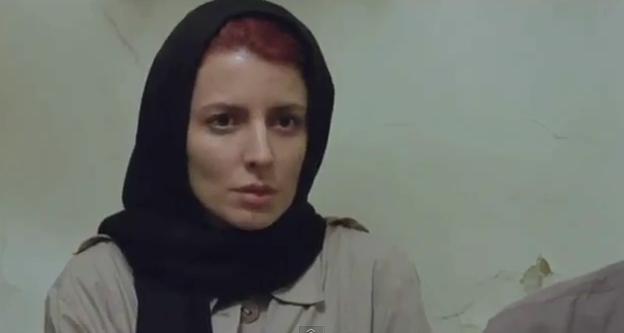
Case in point: I saw the best film of 2011 in March of 2012. The movie was “A Separation,” an Iranian film that just recently won an Oscar for Best Foreign Language Film. The story follows a couple that goes through a divorce and a legal battle with hired help simultaneously. It is, in almost every way, a perfect film, yet because of its status as a foreign film, not to mention an Iranian film, I couldn’t see it until almost two months after 2011 had ended. Those in other cities may never get the chance to see it in theaters.

“A Separation” is a wrenching portrait of a family falling apart, as well as the greatest legal thriller I’ve ever seen. The screenplay and direction, both by Asghar Farhadi, are superb in equal measure. The ensemble of talent is worthy of the masterful film it inhabits. The plot is irresistibly human and relatable. It is only foreign through its language – the story could be told about any culture or any family.

This isn’t the first example of a good film getting lost in translation when distributed in the U.S. With very few exceptions, including Ang Lee’s “Crouching Tiger, Hidden Dragon” and this year’s Best Picture Oscar winner, “The Artist” (a French film, albeit with several American influences), international movies are constantly relegated to the foreign dumpster despite easily relatable themes largely because American distributors are convinced that the language barrier will simply be insurmountable.

Unfortunately, those distributors are proven right time and time again by American audiences that would rather see sequel upon “threequel” instead of fascinating stories that happen to be in different languages. It’s a shame that so many in America and beyond won’t get to see “A Separation,” for example, because it has so much to offer, not only to fans of foreign cinema, but to general audiences everywhere.

That’s where the “foreign” label really fails: it creates a barrier between its American audience and the film itself. A story like “A Separation” would work in any language because it’s so relatable – yet the subtitles at the bottom of the screen drive away audiences.

It’s likely that “A Separation” will see some success thanks to the publicity generated on Oscar night. Rentals of the DVD will probably be quite high for some time on Netflix. A story this great deserves better than that, though. It deserves a place among the classic titles we all regard so highly. It deserves a wide audience and huge grosses. It deserves so much more than it will ever get simply because it’s a human story told in a different language.

Since we do live in Los Angeles, “A Separation” is still playing in several art house theaters around the city, including Laemmle’s Royal Theatre on Santa Monica Boulevard less than 10 miles from LMU. If you have the time, do yourself a favor and go see it. You likely won’t get the chance to see such a compelling, heartbreaking story from American cinema any time soon.

Oscar

Predicting the Oscars against the odds

Originally posted as part of Road to the Gold, an Oscar blog on LALoyolan.com. For original, please refer to: Road to the gold: Predicting the Oscars against the odds – Los Angeles Loyolan.

Oscar

Photo Credit: Flickr Creative Commons

The months of anticipation and blind predictions come to a head this Sunday at the Academy Awards. Amateur and professional prognosticators alike await the Oscars like it’s Hollywood’s holy night. No more second-guessing – the predictions are locked in and all one can do is wait.

While the show itself is likely to be fun and full of good speeches by winners in pretty dresses and sharp tuxedos, the real thrill comes from seeing how well you could read the cards and anticipate who the victors will be. So often, prognosticators will be proven wrong. Occasionally, they’ll be very right. But it’s always an anxiety-filled experience waiting for each of the envelopes to be opened.

Most who attempt to predict what and who will win stick to the eight primary categories: Best Director, Writing (original screenplay and adapted screenplay), all four acting categories and Best Picture. In that spirit, I present to you my predictions for the big races at this Sunday’s Academy Awards.

BEST ORIGINAL SCREENPLAY

I’d love to see Kristen Wiig and Annie Mumolo’s sharp “Bridesmaids” script take the win. It’s so rare to see comedy recognized at the Oscars, but the screenplay about seven different women and one ridiculous wedding party deserves recognition. That said, I don’t think anything can beat Woody Allen’s “Midnight in Paris” screenplay.

BEST ADAPTED SCREENPLAY

Three of the nominees here are also nominated for Best Picture. While the “Hugo” screenplay is larger than life and Aaron Sorkin and Steve Zaillian crafted a really smart script for “Moneyball,” look no further than the rich complexities in the simple subject of “The Descendants” to take the gold.

BEST SUPPORTING ACTOR

“Drive” star Albert Brooks was the major snub here when nominations were announced – the race without him is far more boring. Christopher Plummer (“Beginners”) is the only one with any traction here. The Oscar is his.

BEST SUPPORTING ACTRESS

A Melissa McCarthy (“Bridesmaids”) win would be utterly fantastic, but I think another comedienne, Octavia Spencer, is a lock for “The Help.” If the Academy is overcome in their love for “The Artist,” however, a surprise win for Bérénice Bejo is possible.

BEST ACTOR

This race is between the movie star playing an unknown (George Clooney, “The Descendants”) and the unknown playing a movie star (Jean Dujardin, “The Artist”). As with Best Supporting Actress, an “Artist” sweep could prove beneficial for Dujardin, but Clooney has been racking up most of the early awards. Still, I’d give the edge to my personal favorite in the category: Dujardin.

BEST ACTRESS

Just four years ago, Meryl Streep and Viola Davis acted together in “Doubt,” and now the two actresses and friends are the frontrunners for Best Actress. They’ve each won a sizable amount of precursor awards so neither has the distinct advantage. I’d give the edge to Davis, but never count Streep out – she hasn’t won this specific honor in 29 years and some circles consider her overdue.

BEST DIRECTOR

Very rarely does Best Director award anyone other than the helmer of the Best Picture, but if there is a split, expect Martin Scorcese to win here for “Hugo.” The smart money’s on French director Michel Hazanavicius for “The Artist,” however.

BEST PICTURE

This is a race between four films: “The Artist,” “The Descendants,” “The Help” and “Hugo.” “The Artist” is the frontrunner, but not everyone is as enamored of the silent film as I am. “The Descendants” is not a favorite of mine, but a lot of people appreciate the complexity of the script and Alexander Payne’s direction. “The Help” is celebrated by actors but might lack the support in the technical fields. “Hugo” is a marvel in 3-D, but voters get 2-D screeners and the film doesn’t lend itself to the simpler format. Ultimately, look for “The Artist” to capitalize on the love for cinema permeating this year’s nominee and its impressive precursor award streak. It should win and it will.

Oscar

Diversity of Direction

Originally posted as part of Road to the Gold, an Oscar blog on LALoyolan.com. For original, please refer to: Diversity of Direction – Los Angeles Loyolan : Road To The Gold.

Oscar

Photo Credit: Flickr Creative Commons

Forget the golden days of merely two years ago: there is no diversity allowed in the Best Director Oscar race.

Save a few extraordinary directors such as Ang Lee (“Brokeback Mountain”) and Jane Campion (“The Piano”), recognition of anyone who doesn’t fit into the slim “older-white-male” demographic seemed nigh impossible for the Best Director voting body in the Academy.

When “The Hurt Locker” director Kathryn Bigelow won the statuette in 2010, her victory was seen as a sign of changing tides in the white men’s club that the Best Director race has always been. After all, in the same year, Lee Daniels (“Precious”) was only the second African-American man ever to be nominated for the same award (after John Singleton). Unfortunately, in the years since, the Academy has reverted to what is familiar once again.

Last year, the overflow of white, male directors was acceptable simply because they were almost all young and ambitious. The winner, Tom Hooper, directed “The King’s Speech,” and while his film appealed primarily to older audiences, he is a young man. David Fincher, director of “The Social Network,” and Darren Aronofsky, director of “Black Swan,” are both incredibly ambitious and respected in film criticism circles. Even the veterans of the category, David O’Russell (“The Fighter”) and Joel and Ethan Coen (“True Grit”), are a much different brand than the usual directing nominees.

This year is not an exception to the rule. Certainly, Woody Allen (“Midnight in Paris”), Alexander Payne (“The Descendants”) and Martin Scorsese (“Hugo”) are masters of their craft, and Michel Hazanavicius (“The Artist”) and Terrence Malick (“The Tree of Life”) are certainly ambitious, but they are very much the stereotype of a Best Director nominee. The youngest of the five is Hazanavicius at 44 – not coincidentally, he is the only first-time nominee. All the others have been here before; Scorsese and Allen have both won previously as well.

Why not nominate the young Danish director Nicolas Winding Refn for “Drive”? Or how about the female African-American director of the ambitious “Pariah,” Dee Rees? There’s nothing wrong with stacking a category with lots of experience – in fact, the Best Director race should theoretically reward experience more than any other. It is a little disappointing, however, that ambition and diversity can’t be rewarded in equal measure. As far as the winner, look no further than Hazanavicius. The youngest will be rewarded thanks to his film’s almost certain dominance of the show next Sunday.

The Bacchae of Euripides

Strong performances carry difficult ‘Bacchae’ material

Originally published in the Los Angeles Loyolan. For orignal, please refer to: Strong performances carry difficult ‘Bacchae’ material – Los Angeles Loyolan.

The Bacchae of Euripides

Photo Credit: Devin Sixt | The Los Angeles Loyolan

It can be said that “The Bacchae of Euripides,” the newest production by LMU’s theatre arts and dance department, is a strange show. It is an intense show. It is a challenging show. But most importantly, it is a masterful show.

Based on “The Bacchae,” a Greek tragedy written by Euripides, and first performed in 405 BC this version, written by the President’s Marymount Institute Professor in Residence Wole Soyinka, is an African interpretation with powerful musical moments. It requires incredible levels of commitment from each member of the ensemble cast and sky-high energy levels, and under the direction of theatre arts professor Kevin Wetmore, “The Bacchae of Euripides” is a success because it achieves both.

The story is based on the myth of King Pentheus, a man who refuses to follow Dionysus, the god of wine (amongst other things). Pentheus and his mother, Agave, are both punished, as she is possessed by the same bloodlust and passion as Dionysus’ other female followers. Behind the basic plot are greater themes, including the battle between creation and oppression. This production communicates these themes through commanding dance and music.

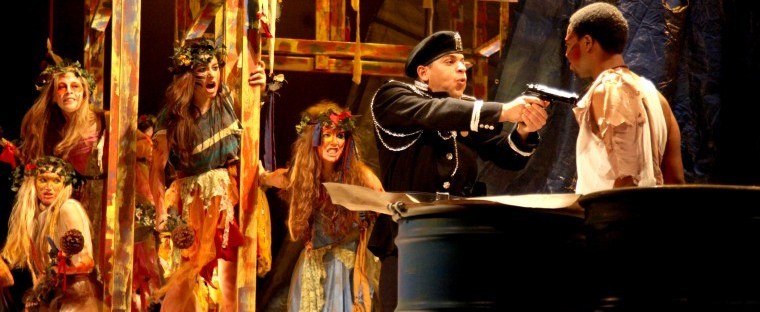
Wetmore chose to create a sense of controlled chaos in the production, with modern and classical sensibilities merging in powerful fashion. The set, designed by theatre arts professor Maureen Weiss, is absolutely incredible, almost a jungle gym on a sparse stage that is used as setting, prop and musical instrument. Every inch of the stage is used, with actors venturing into the audience for even further exploration of the space. The costumes, which were created by visiting theatre arts professor Sara Ryung Clement, are an interesting mix of African and post-apocalyptic design, a fascinating choice and one that works really well.

While the play is incredibly visually appealing, it could only reach truly masterful status with the help of a strong, committed ensemble of actors. The dialogue is challenging and the choreography demanding, so both require nothing less than top-notch work from all involved. Luckily, there are only a few weak links here – almost every performer does stunning work. Sophomore theatre arts major Julian Garcia is especially stunning as King Pentheus. From his first line, he commands attention and owns the stage with volume and authority. His range is awe-inspiring and his sheer skill is impressive.

Many other members of the ensemble join Garcia in energetic and expressive work. Two that stand out are senior theatre arts major Jeremy Larrere as Tiresias, the blind priest, and freshman theatre arts major Keeley Miller as Agave. Larrere fully inhabits his character, playing not only the dramatic moments but also making the awkward attempts at humor bearable. Miller’s Agave is all about the drama and is something of a one-scene wonder, only appearing during the play’s final moments. But the revelation of her character’s actions is ambitious and impressive.

Several members of the ensemble are given powerful monologues that rarely slow the pace of the show – instead they act as showcases for each performer, even those in otherwise minor roles. Freshman theatre arts and communication studies double major Gabriel Gonzalvez truly wrings every dramatic drop out of his monologue, breaking out of the simple Officer role and making an impact. Junior theatre arts major Nelia Miller gets multiple monologues as the leader of the slaves and knocks each and every one out of the park.

“The Bacchae of Euripides” is not without its faults, however. As mentioned previously, there are several incredibly lowbrow stabs at humor that fall short, especially considering the powerful scenes surrounding them. Why the otherwise devastatingly potent production chose to dilute the drama with painfully unfunny penis jokes and men in drag is beyond me. Additionally, there are several scenes of both the comic and tragic variety that seemed to last forever, affecting the pacing of the show negatively. This production is at its best when it is fast-moving and there’s plenty going on – watching one actor lecture another for 10 minutes is nothing but a hindrance.

Those scenes and choices, though unfortunate, cannot derail what is ultimately a brilliant production. “The Bacchae of Euripides” is more than just a play. It is art in motion with commanding performances by committed actors. It is not to be missed.

“The Bacchae of Euripedes” is now in the middle of its run at Strub Theatre. It has three shows remaining, starting with tonight’s performance, at 8 p.m. Tickets are $10.