Greek groups reflect on probation

Originally published in the Los Angeles Loyolan. For original, please refer to: Greek groups reflect on probation – Los Angeles Loyolan.

Three Greek organizations have recently come off social probation, while a fourth remains on probation indefinitely.

Lambda Chi Alpha, Sigma Chi and Sigma Phi Epsilon fraternities were on probation from the beginning of the academic year until the first of this month, according to junior political science major Michael Hanover, Sigma Phi Epsilon’s chapter president.

According to sophomore political science major Alex Petosa, a member of Alpha Phi sorority, these suspensions came about because of the same event last semester that put Delta Gamma sorority on a still-continuing social probation.

“It was an event involving the introduction of new Delta Gammas to members of fraternities,” Hanover confirmed. “As far as I know, somebody got sick [for alcohol related reasons] and everybody there was held accountable.”

In a statement released to the Loyolan through Chapter President Libby de Leon, a senior history and screenwriting double major, Delta Gamma confirmed that their chapter did indeed receive sanctions from the University and the national Delta Gamma Fraternity for “behavior that did not align with our mission.”

The organizations were held accountable in a process outlined in LMU’s Community Standards, according to Assistant Director of Student Leadership and Development and Greek Adviser Dan Faill.

“In any organization, as with being human in general, people make mistakes,” Faill wrote in an email to the Loyolan. “If people make mistakes at organization-related activities, the organizations will be held accountable. … It’s my job to ensure a safe and fun Greek experience; sometimes that comes with holding sorority [and] fraternity members and organizations to a higher standard.”

“Traditionally, if you look at any other school, everyone does that kind of stuff,” Petosa said regarding the difference between LMU and other universities’ Greek life. “It’s a conflict between LMU’s ideals and what Greek Life is. … We go to a Jesuit university, and so Greek Council and Dan Faill have a standard to uphold. And they have to uphold the school’s mission statement.”

According to senior psychology major Lisa Flanigan, president of Kappa Alpha Theta, Delta Gamma remains on probation.

“They were definitely put up as an example,” Petosa said of Delta Gamma’s longer probation. “I think it’s the historical example that no one’s perfect. … It’s just too bad it had to happen. … They had to be upheld as an example. They violated the rules, and rules are rules. That’s in LMU’s standards.”

As part of the probations, each chapter was delivered sanctions by the University’s Judicial Affairs department. For Sigma Phi Epsilon, the sanctions included “education on risk management, how to conduct safe events and not make stupid mistakes,” according to Hanover. The organization was also prohibited from hosting any events with alcohol.

“I think that the sanctions that were levied upon us were very reasonable and educational,” Hanover said. “They were all directed towards teaching us how to keep our members safe and conduct themselves in a way that was more healthy and conducive to development in the future.”

The terms behind social probations are determined on a case-by-case basis. According to Faill, they depend on the group and any alleged violations.

Just three semesters ago, Kappa Alpha Theta was placed on social probation as well.

“We had an event where girls were drinking alcohol on campus. It was a dry event,” Flanigan said. “The school found bottles of alcohol … in a bathroom.”

Like Delta Gamma, Kappa Alpha Theta received sanctions not only through the University, but also through the national organization. According to Flanigan, her chapter had a number of sanctions levied upon it.

“I don’t remember everything that we had to do – we did a bunch of things – but one of the things that we did recently for LMU was an educational program for the LMU community about drinking and driving,” Flanigan explained. The program involved bringing a smashed car from Mothers Against Drunk Driving (MADD). Additionally, Kappa Alpha Theta held a service day for workers at LMU.

Kappa Alpha Theta’s probation wound up lasting for a semester, something that Flanigan said is not common. The time was spent bonding as a chapter and making up for their mistakes.

“We always say that we think being on probation really helped our organization become even better, because we were able to take a step back and look at our true values and morals of our organization, where we were and where we needed to be,” said Flanigan.

In its statement, Delta Gamma echoed that sentiment, saying that its chapter is “appreciative for the learning opportunity and [we] look forward to continuing to work with the University and various groups on campus to build awareness about safety, risk management and social responsibility.”

“I think this whole thing was a culture shock for us. We got to see how things could go wrong,” Hanover said of the fallout from the probations. “I think the whole community learned a lesson from this.”

When asked what advice she would give current organizations on or coming off probation, Flanigan said, “I think that it’s really important to take a step back and look at why you’re in this organization, why all you girls or boys … are in an organization that has certain values and why you joined that organization over others.”

She added, “You have to make the most out of it.”

David Koechner

‘Anchorman’ star David Koechner named Comedy for a Cause headliner

Originally published in the Los Angeles Loyolan. For original, please refer to: ‘Anchorman’ star David Koechner named Comedy for a Cause headliner.

David Koechner

Photo Credit: YouTube | roryphotography

ASLMU’s Comedy for a Cause, previously known as both Comedy for a Cure and Comedian for a Cure, has found its headliner: “Anchorman” star David Koechner.

“He’s in ‘The Office,’ he’s in ‘Anchorman’ … so he’s been in the public view a lot,” said ASLMU’s Director of Performance Events and senior finance major Ashley Thompson of the choice. “We looked at his stand-up comedy style, and he’s what we wanted. He’s available and lives in L.A. – kind of a match made in heaven.”

The actor/comedian, who has also played recurring character Todd Packer on “The Office” since 2005 and was a “Saturday Night Live” cast member in the show’s 21st season, was selected in mid-September.

ASLMU President and senior marketing major Bryan Ruiz said that he thinks Koechner’s reprisal of his role as sportscaster Champ Kind in the tentatively-titled “Anchorman: The Legend Continues” next year will drive students to the event.

“Especially with Anchorman 2 coming out … I feel that students are going to respond really well,” Ruiz said. “We [at ASLMU] were all ecstatic.”

Opening for Koechner at the event will be this year’s Last Student Standing winner, junior screenwriting major Justin Small.

Under the event’s new title, Koechner was asked to choose which charity the event’s funds would support.

“In the past, the event has benefited the Susan G. Komen Foundation,” Thompson said. “This year, we decided to open up the philanthropy to the comedian. So we asked David … [and] he chose the Balanced Mind Foundation.”

The Balanced Mind Foundation, a Chicago-based foundation first established in 1999, is an organization with the goal to guide “families raising children with mood disorders to the answers, support and stability they seek,” according to their website.

To raise money for the Balanced Mind Foundation, junior psychology major Caitlin Maher, ASLMU’s chair of programming, said that the event’s coordinators have been focusing on fundraising opportunities.

“One of our major goals that we’ve been focusing on is just getting a lot of donations from different businesses, so we can donate a significant amount of money to the foundation,” Maher said. “Because that’s what the whole entire event is centered around.”

Fundraising opportunities include a raffle that will include prizes like gift cards to Best Buy and C&O Cucina, as well as tickets to Six Flags Magic Mountain. According to Maher, ASLMU is also hosting a Pinkberry fundraiser on Sunday, Oct. 20.

Comedy for a Cause will be held Tuesday, Oct. 23, at 7 p.m. in Gersten Pavilion. The event will be free, but raffle tickets to be entered for a prize will cost $5 for one and a discount $10 for three, and will go on sale starting tomorrow during Convo.

11 Burning Questions with an L.A. Times editor

Originally published in the Los Angeles Loyolan. For original, please refer to: 11 Burning Questions with an L.A. Times editor – Los Angeles Loyolan.

Photo Credit: John Corrigan

1) How did you first get involved at the L.A. Times?

I’ve been involved with the L.A. Times since 1999. I was hired as the night city editor and the business editor for the San Fernando Valley. I was a screenwriting major here at LMU, and when I graduated I couldn’t figure out how to become a screenwriter. So I ended up getting into a Master’s program at [CSU] Northridge in communications. From there, I managed to get an [unpaid] internship at the L.A. Times and some clips.

2) How did you transition from your old position as business editor to your current post?

The former [assistant managing editor] had left the organization. The editor, Davan Maharaj, approached me to take it over. I had been associated with some quality journalism projects – I edited our Wal-Mart series that won the Pulitzer in 2004. … [Maharaj] was aware of my arts background and thought it would be a good fit.

3) As assistant managing editor for arts & entertainment, what is your goal for the section?

My goal is to have the best arts & entertainment section in the country. We live in the entertainment capital of the world, and we have special access to filmmakers, to actors, to producers. What I want to have is both print and online content people really want to read that is useful, compelling [and] thought-provoking.

4) What do you think arts & entertainment can do that is special?

Especially in this era of the Internet and instant news, if you look at the hard news headlines, a lot of the time the stories on the front page or in the news sections people have some familiarity with. … Arts & entertainment has the unique position where most of the stories on our cover, people may not have a familiarity with.

5) How do you feel your work in business sections informs your current work?

In business in particular, you get a discipline of looking beyond what people say to [the] numbers and information. … When you are covering the showbusiness elements of the entertainment industry, it does force a certain mindset to try to find facts to go with the words — to look a little deeper and harder for information.

6) Do you feel your screenwriting major background makes you more drawn to film in arts & entertainment?

Screenwriting was really helpful [to me] in being a journalist. … When you’re writing about features or events, you have to think [about] storyline, the plot and characterization. When you’re writing about people, you want those people to come to life.

7) Did you write for the Loyolan back in your LMU days?

I did indeed. I remember covering Bobby Seale, the Black Panther who came to campus … that was on Page 1 of the Loyolan. And I believe my first assignment [was about how] at the time, people would park on campus and their windshields were leafleted with ads from a term paper research company.

8) We featured a debate (“How real is too real?” in the Sept. 20. Loyolan) about the photo of the Libyan ambassador that ran on the front page of the L.A. Times. Can you speak at all to the decision making behind that?

I really can’t. I was not directly involved in that decision.

9) You sit on the LMU Magazine advisory board. What do you do in that role?

We meet about four times a year to review the magazine and make suggestions. … One of the big audiences is alumni, and so I thought pictures of what’s going on on-campus now, that’s important – more stories to just bring you back to campus.

10) What do you hope to bring in your speech to the Loyolan staff? [Editor’s note: Corrigan spoke at the Loyolan’s staff meeting last Monday.]

To me, journalism is really a wonderful pursuit. … Years ago, reporting was very strict: not opinion … only a few people could be commentators or have opinions. Increasingly, though, with so much news out there … there is a chance for analytical writing, for opinion writing. … There’s something about writing that is strong.

11) If you boiled your life down to a headline, what do you think it would be?

“Making the most out of life.”

LMU adds two new fraternities on campus

Originally published in the Los Angeles Loyolan. For original, please refer to: LMU adds two new fraternities on campus – Los Angeles Loyolan.

A process that began in Spring 2012 has finally born fruit: Two new fraternities will be joining LMU’s Greek Life over the next two years.

Delta Sigma Phi and Phi Delta Theta, two national fraternities, will be establishing chapters in this and the next academic year, respectively.

“These organizations were not only a strong match with our institutional mission and values, they offer the resources necessary to start and maintain a successful fraternal chapter at LMU,” said Assistant Director of Student Leadership and Development (SLD) and Greek Adviser Dan Faill in a letter to leaders in the LMU and Greek Life communities sent this past June.

DeMarkco Butler, the director of expansion for Phi Delta Theta, spoke optimistically about the effect the new fraternity will hopefully have on campus.

“I believe Phi Delta Theta will complement the already great culture that the Greek community has by adding another strong international fraternity,” he said. “Additionally, we look to bring new recruitment tactics [and] foster healthy relationships amongst [Loyola] Marymount University and [the] Greek community.”

The process of expanding the number of fraternities on campus began with Student Leadership and Development (SLD) determining that the campus could support further growth in the Greek Life community. According to the Greek Life policies in LMU Community Standards, SLD is the only organization on campus that can initiate an expansion process.

According to Faill’s letter, the process is a direct response to low recruitment ratios among fraternities in recent years. “In Spring 2012, nearly 60 percent of eligible men who registered for fraternity recruitment were not offered an invitation to join one of our registered groups. However, our six registered fraternities still saw increased membership numbers,” the letter said. “It became evident more opportunities for our undergraduate men were needed.”

Current LMU fraternity Sigma Phi Epsilon’s President Michael Hanover recognized the need for more fraternities as well. “The number of men that rush versus the ratio that actually get bids is much lower than that of sororities. And I think that’s unfortunate,” he said. “I don’t know how to fix that besides adding new fraternities, because I believe that each fraternity should have the right to choose, and I don’t think that forcing certain recruitment practices on a chapter is fair.”

The two fraternities were chosen from a pool of six that gave presentations on campus. That pool was narrowed down from 12 fraternities that submitted informational packets to the University in March. The informational sessions were held on campus in April.

The Fraternity Review and Fraternity Expansion Committees, according to Faill’s letter, “spent many hours reviewing application materials from various organizations, discussing the values and match with LMU and interviewing the finalists.” The committees included representatives from University Relations, Student Life, SLD, Ethnic and Intercultural Services, Greek Council and the presidents of three current fraternities and two sororities.

Hanover, a junior political science major, first heard of the expansion at the beginning of his presidential term in spring. However, according to the letter sent by Faill, Sigma Phi Epsilon was the only fraternity without a representative in the expansion process. (Lambda Chi Alpha, Alpha Delta Gamma and Beta Theta Pi’s presidents all served on one of the committees, while Sigma Chi’s Joe Dzida participated in his capacity as Greek Council president.)

“I knew that there were 12 possibilities, I knew that there were six informational sessions, I believe I attended one,” Hanover said. “I read through some of the books that each fraternity submitted. Other than that, I was absolutely uninvolved. I wish I had a little more opportunity to give some input.”

According to Hanover, the members of Sigma Phi Epsilon have been informed by the head of their alumni volunteer corporation as to what exactly happens when a new fraternity joins campus.

“The thing I’ve been focusing on as I think about it is how their national headquarters … will step in and basically take care of them and all their needs, help them with recruiting and that kind of thing,” he said. “So it’s not just a new group of students organizing. It’s more than that. It’s a national group creating a new body of students here on campus.”

“To prepare for the LMU colonization, we will do a few things,” Butler said. “[We will] host a Phi Delta Theta alumni reception that will inform the area alumni on our upcoming expansion project at LMU [and] build a Chapter Advisory Board that consists of Phi Delta Theta alumni, non-Phi Delt affiliates, non-Greek men/women professionals and University officials.”

On his end, Hanover is “flat-out excited” to see how the new fraternities form. As his presidential term winds down, however, he spoke of leaving a legacy of acceptance of these new fraternities to his brothers.

“All I would tell the other guys [in Sigma Phi Epsilon] is that everybody deserves an opportunity to form an organization and to make it the best that they can, and all I’d tell them is, ‘Wish those guys the best of luck. Help them out when you can. Give them advice when you can,’” he said. “‘But always focus on … making Sig Ep the best that you can to the best of your abilities.’”

new recruitment tactics [and] foster healthy relationships amongst [Loyola] Marymount University and [the] Greek community.”

The process of expanding the number of fraternities on campus began with SLD determining that the campus could support further growth in the Greek Life community. According to the Greek Life policies in LMU Community Standards, SLD is the only organization on campus that can initiate a Greek Life expansion process.

According to Faill’s letter, the process is a direct response to low recruitment ratios among fraternities in recent years. “In Spring 2012, nearly 60 percent of eligible men who registered for fraternity recruitment were not offered an invitation to join one of our registered groups. However, our six registered fraternities still saw increased membership numbers,” the letter said. “It became evident more opportunities for our undergraduate men were needed.”

Current LMU fraternity Sigma Phi Epsilon’s President Michael Hanover recognized the need for more fraternities as well. “The number of men that rush versus the ratio that actually get bids is much lower than that of sororities. And I think that’s unfortunate,” he said. “I don’t know how to fix that besides adding new fraternities, because I believe that each fraternity should have the right to choose, and I don’t think that forcing certain recruitment practices on a chapter is fair.”

Two fraternities were chosen from a pool of six that gave presentations on campus. That pool was narrowed down from 12 fraternities that submitted informational packets to the University in March. The informational sessions were held on campus in April.

The Fraternity Review and Fraternity Expansion Committees, according to Faill’s letter, “spent many hours reviewing application materials from various organizations, discussing the values that match with LMU and interviewing the finalists.” The committees included representatives from University Relations, Student Life, SLD, Ethnic and Intercultural Services, Greek Council and the presidents of three current fraternities and two sororities.

Hanover, a junior political science major, first heard of the expansion at the beginning of his presidential term in spring. However, based off the letter sent by Faill, Sigma Phi Epsilon was one of two fraternities without a representative in the expansion process. (Lambda Chi Alpha, Alpha Delta Gamma and Beta Theta Pi’s presidents all served on one of the committees, while Sigma Chi’s Joe Dzida participated in his capacity as Greek Council president.)

“I knew that there were 12 possibilities, I knew that there were six informational sessions, I believe I attended one,” Hanover said. “I read through some of the books that each fraternity submitted. Other than that, I was absolutely uninvolved. I wish I had a little more opportunity to give some input.”

According to Hanover, the members of Sigma Phi Epsilon were informed by the head of their alumni volunteer corporation as to what exactly happens when a new fraternity joins campus.

“The thing I’ve been focusing on as I think about it is how their national headquarters … will step in and basically take care of them and all their needs, help them with recruiting and that kind of thing,” he said. “So it’s not just a new group of students organizing. It’s more than that. It’s a national group creating a new body of students here on campus.”

“To prepare for the LMU colonization, we will do a few things,” Butler said. “[We will] host a Phi Delta Theta alumni reception that will inform the area alumni on our upcoming expansion project at LMU [and] build a Chapter Advisory Board that consists of Phi Delta Theta alumni, non-Phi Delt affiliates, non-Greek men/women professionals and University officials.”

On his end, Hanover is “flat-out excited” to see how the new fraternities form. As his presidential term winds down, however, he spoke of leaving a legacy of acceptance of these new fraternities to his brothers.

“All I would tell the other guys [in Sigma Phi Epsilon] is that everybody deserves an opportunity to form an organization and to make it the best that they can,” he said.

He added, “all I’d tell them is, ‘Wish those guys the best of luck. Help them out when you can. Give them advice when you can.”

Spencer Sharpe

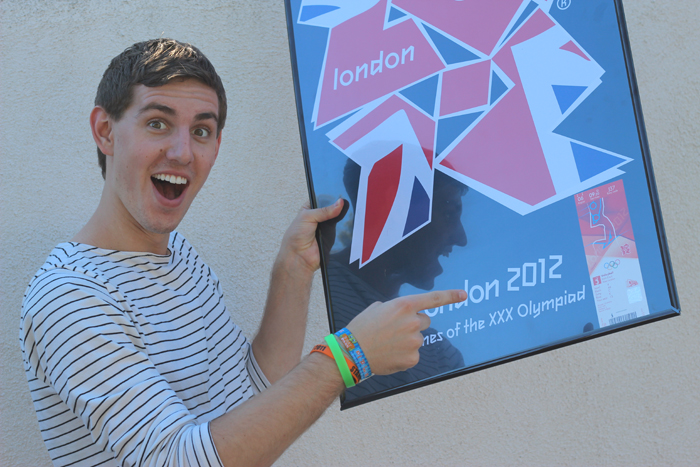
11 Burning Questions with a 2012 Olympic attendee

Originally published in the Los Angeles Loyolan. For original, please refer to: 11 Burning Questions with a 2012 Olympic attendee – Los Angeles Loyolan.

Spencer Sharpe

Photo Credit: Liana Bandziulis | The Los Angeles Loyolan

1. How did you get the opportunity to attend the Games?

I learned about a program at the London School of Economics and Political Science through one of my friends who actually was a graduating [LMU student and] Ignatian last year. … I then checked the dates and realized they lined up with the Olympics. So it was kind of an accident.

2. What events did you see?

I saw men’s volleyball. That’s the only thing I could get tickets to, actually, because they stopped selling tickets to Americans. … I was asking at an information booth, “I’m just looking for a ticket. I really don’t care what it is, any event.” And the guy next to me said, “I have some extra tickets, I’m not gonna be able to go to this event. I’ll sell them to you at the same price I paid for them.” And people were paying, like, five to 10 times the value of the ticket, so for 20 pounds, I said yes, and I got to go to the men’s volleyball match between Poland and Australia, and it was really cool. Most people weren’t rooting for a specific team, so every time a point was scored, the audience went crazy.

3. Who was your favorite Olympian this year?

It would have to be Michael Phelps. I still think he’s a god. I think he’s amazing in the fact that he can come back after four more years have gone by and still win gold against brand new athletes and younger athletes.

4. Has it been a goal of yours to go to the Olympics?

More of a dream. I’m originally from Iowa, so I never really thought it would be possible, because the Olympics aren’t coming to Iowa, ever. I never really imagined I’d get the opportunity, so this huge accident was kind of fulfilling one of my dreams.

5. Do you feel you can go back to watching the Olympics on TV after seeing them in person, or will it just not compare?

There’s no comparison anymore. I got the opportunity to watch the Olympics with a whole bunch of people from all around the world, because it was a very international school that I went to, so it was really exciting, watching it there in the city with those people.

6. Do you consider yourself more of a summer Olympics guy or do you prefer the winter Olympics?

I definitely like summer. There are more events I can watch that are more suspenseful. … My sister’s really into soccer, so my family’s a big soccer family, so we always watch those games. I really think the equestrian events are cool, the swimming is awesome, the diving is fun. [Spencer’s sister is LMU soccer team captain and senior Whitney Sharpe.]

7. What else did you do while in London?

I did a lot of cultural stuff, and I did a lot of nerdy stuff. I went to the British Museum, the British Library, and I got to see some of J.K. Rowling’s handwritten [pages] of the first Harry Potter ever, and the first ever drawing of the Shire from “The Hobbit.” The best thing to do … was the pubs you could go to, just because there were people from all around the world at every single pub that you went to, and it was just so international and such a world city at that time.

8. If you could compete in one Olympic event, which would you choose?

I would do the high dive, because I think that’s fascinating. I really think that being up that high and jumping would get my adrenaline rushing.

9. For freshmen reading the Loyolan for the first time, what advice do you have for them?

I’d say, really, if you’re trying to get a solid GPA, don’t take your first classes as a joke. Really focus on your coursework. … Don’t forget that you’re here for school.

10. What are you involved in on campus?

I am an Ignatian, and I’m working on starting a new organization on campus, but it doesn’t exist yet. It’ll be a policy-based organization. Our idea, me and a few other Ignatians, is that it [will focus on] issues that affect Los Angeles. So homelessness, economic issues, environmental issues. We’re going to find professors at LMU who study that issue and then what we’re going to do is with them, create a type of policy proposal or a solution to that problem. Just in a sense of hoping LMU students become more aware of issues that affect Los Angeles so we can offer real solutions. (online only)

11. What are your big hopes for LMU during in its 101st year?

I hope that LMU continues to create a great reputation. I feel like with our 100th year, more people were becoming aware of our University, because it’s mostly a regional school, I’d say. So I hope we continue projecting our image both nationally and internationally, so that eventually our school could be a little more recognized. … I just don’t think people take LMU as seriously as they should.

12. LMU’s LGBTSS is staging a presentation of the play “8,” about Proposition 8 and marriage equality, in early September. The decision has just started to get a little flack. Thoughts?

As someone who’s a bisexual individual, I really do care about this issue. … What I think the University should recognize, as I think they did by [allowing] this, that they have a wide range of students. Not every student is a Catholic or a Jesuit, so I think by LMU allowing it to go forth, in a sense it’s kind of addressing the fact that many different students go here, and they will support and bring awareness to every issue, even if it goes against religious affiliation. I hope that LMU does not cave to this outward pressure. … If they really stood their ground, that would be very respectable in a university, and as a bisexual, I would feel like my university supported me, and didn’t have a sense of a ‘don’t ask, don’t tell’ policy, just because it’s a Catholic university.