Bryan Ruiz, ASLMU President

Ruiz, ASLMU stay true to goals

Originally published in the Los Angeles Loyolan. For original, please refer to: Ruiz, ASLMU stay true to goals – Los Angeles Loyolan.

Bryan Ruiz, ASLMU President

Photo Credit: Bryan Ruiz

The Friday before the new academic year began in earnest, ASLMU President Bryan Ruiz professed his excitement about the upcoming First Convo, co-sponsored by Mane Entertainment.

“At First Convo this year, expect something you’ve never seen before to kick off this 101st year,” the senior management major said in an interview with the Loyolan. “Expect something new and fresh. We’re kicking it up one notch with all of our events.”

Ruiz’s enthusiasm wasn’t reserved for First Convo; whether he was talking about ASLMU’s open-door policy, its new focus on transparency or all the student government’s goals for LMU at 101, the president was eager for the new year to begin.

Fast forward to First Convo on Tuesday, Aug. 28 and the “new and fresh” element, it turned out, was a live lion on campus. While many students celebrated the decision (“LMU at 101! There was a real lion on campus today. Hurra[h] for senior year!” senior entrepreneurship major Michelle Figueroa tweeted from what appeared to be her account), there were murmurs across campus of concern for the lion’s safety, as well as frustration over the expense of this event. The Aug. 30 Loyolan’s Letter to the Editor from Associate Professor of Communication Studies Dr. Nina M. Lozano-Reich went so far as to call for a public apology for the lion’s appearance.

In an open letter to the LMU community, Ruiz spoke for ASLMU about First Convo and said, “As student leaders, we had intentional conversations about both positive and negative outcomes of bringing a lion to campus. … Although we believe we did our due diligence to research the best possible organization to accomplish our vision, we also realize that our actions have offended members of the LMU community, and for that we are regretful.”

Despite the controversy, Ruiz still called it a “very successful event” when speaking with the Loyolan.

First Convo was set to be the catalyst in the Ruiz administration’s push for “quality over quantity” in event planning, a theme stressed not only since the student body’s return, but also back in the election season. Since the controversy, Ruiz admitted that his administration is “adjusting” its event planning strategy going forward.

“We’re always adjusting. Nothing’s perfect, and we’re all learners every day,” he said. “At ASLMU, we’re going to keep adjusting our events to cater to our student body.”

Programming goals aside, Ruiz and his vice president, senior sociology major Vince Caserio, are focusing on two other major goals during LMU’s 101st year.

“[Vince] and I are really friendly and extroverted guys,” Ruiz said in reference to their open-door policy. “We [want to] make sure that everybody knows that ASLMU is home for everyone. … I think what’s most effective is face-to-face [interaction], actually being there.”

Caserio also spoke of increasing communication with the administration. According to the vice president, ASLMU’s plan is to meet with faculty groups every month.

“We know they want the students’ best interest as well,” Caserio said. “We just want to make sure everyone’s voice is heard.”

Ruiz and Caserio also stressed a need for greater transparency as one of their goals, citing as evidence the student body’s anger at not being informed of the reasoning behind the decision to terminate the De Colores service trips last semester.

“I think students felt like they really didn’t have a voice,” Ruiz said. “So, Vinnie and I want to make sure students do have a voice in things.”

However, Ruiz also urged looking forward at future issues, rather than looking back at incidents like De Colores and the controversial introduction of parking fees. “I would be lying to tell you that I could change anything. It’s more of an informational piece. … It’s [about] informing students, ‘This is what happened; that wasn’t under my era, but this is what’s happening. I want to make sure you’re up to date with everything.’”

The executive team spoke of feeling ready to leap into the new academic year with the support of what Speaker of the Senate Cecilia Rangel-Garcia described as a “positive and excited” ASLMU staff.

“This year, there aren’t that many returners,” the sophomore psychology major said about the Senate in particular. “It’s a different dynamic. I really appreciate the enthusiasm that everybody has.”

Ruiz echoed her sentiments, indicating an infectious energy in ASLMU’s ranks as they face a year of new challenges and a currently unclear LMU at 101.

“This ASLMU team, I feel, is [going to] set a new structure and foundation for future administrations,” Ruiz said. “What’s going on here is something special.”


Don’t hate the “8”

Originally published in the Los Angeles Loyolan. For original, please refer to: Should “8” play?: Don’t hate the “8” – Los Angeles Loyolan.

Graphic Credit: Alberto Gonzalez | The Los Angeles Loyolan

It shouldn’t even be a debate.

I’ll admit – I’m curious as to what fellow contributor Lauren Rockwell’s argument is regarding the LGBT Student Services (LGBTSS) Office’s presentation of “8,” the pro-marriage equality play, at LMU tomorrow night. From my point of view, not as an LGBT individual, nor as someone who is pro-marriage equality, but simply as an LMU student, I fail to see a single valid reason why the play shouldn’t be read on our campus.

Agree or disagree with what the play is arguing, the fact is that the show must go on, not because of the subject matter, but because it is an expression of a faction of students’ opinions. Their voices deserve to be heard.

For those who aren’t familiar with the play, “8” is a dramatic interpretation of the Perry v. Schwarzenegger trial currently headed for the Supreme Court. The case is about the constitutionality of Proposition 8, the infamous amendment to the California constitution that banned same-sex marriage in the state. Written by Dustin Lance Black, the Academy Award-winning screenwriter of “Milk,” “8” is an unabashedly biased and activist look at the trial, but it never pretends to be anything else.

Controversy brewed about the presentation of “8” on LMU’s campus when The Cardinal Newman Society posted an article about this on its blog. The post, which has been picked up by a couple other Catholic blogs but has failed to make a dent in the greater media sphere, argues that LMU is promoting gay “marriage” (complete with incredibly condescending quotation marks) through its production of “8.”

What The Cardinal Newman Society fails to understand is that if LMU were to shut down the production of “8,” the University would be silencing student voices simply because they are at odds with the Catholic Church’s positions – a terrifying proposition, and completely at odds with the Jesuit mission to educate the whole person and encourage learning, as LMU’s mission statement reads.

When asked about “8” in an interview with the Loyolan, ASLMU President Bryan Ruiz said that he believes LMU students’ self-expression “does need to be heard.” LMU and President David Burcham are clearly working with the same mindset, and their refusal to cancel the show is inspiring.

I’m incredibly proud to go to a religiously-affiliated school that is comfortable presenting a pro-marriage equality play on its campus while not fully endorsing it. To endorse the show would indeed be a violation of the Catholic position, something we shouldn’t ask the University to do. But to shut it down would violate our mission. So in truth, President Burcham and his administration have done the only thing they can do without appearing hypocritical to some part of the University’s identity.

You’ll notice I haven’t talked much about why I think “8” is so great and how important the message it will spread to students is. That’s because “8” isn’t great, and I think said important message is something the majority of our student body already supports.

On paper, “8” is a clumsily written play, full of preachy monologues and an unwillingness to portray marriage equality opponents as anything but morons. The marriage equality debate deserves a better dramatic interpretation, and I have no doubt that several years down the road, we’ll see one. But a show being bad isn’t any reason to censor it from running. As the Loyolan’s primary theatre critic for the past two years, I’ve certainly seen shows I didn’t like, but you never once heard me call for their cancellation out of sheer disgust. Besides, the point of “8” isn’t to be great theatre – it’s activist in nature.

The message it is spreading, however, is something I think most students on this campus and across the country already feel: Marriage equality is the right thing for right now. Even among young conservatives in the U.S., support for same-sex marriage is rapidly rising. A Washington Post-ABC News poll from May shows that almost half of young conservatives do indeed support marriage equality – and among young liberals, that number is sky-high. So, I don’t necessarily think a college campus, even a Jesuit one like LMU’s, is the most effective stage for a play like “8.”

What does any of this matter? Simple: It doesn’t. No matter how bad the play is, how repetitive its message may be or how much it may get The Cardinal Newman Society’s panties into a bunch, there is simply no valid reason to cancel “8.” At the end of the day, this is about students’ free expression, and we go to a school that values said expression.

That’s something worth celebrating, not debating.

How the Other Half Loves

Cast and staging appeals in ‘How the Other Half Loves’

Originally published in the Los Angeles Loyolan. For original, please refer to: Cast and staging appeals in “How the Other Half Loves” – Los Angeles Loyolan.

How the Other Half Loves

Photo Credit: Kevin Halladay-Glynn | The Los Angeles Loyolan

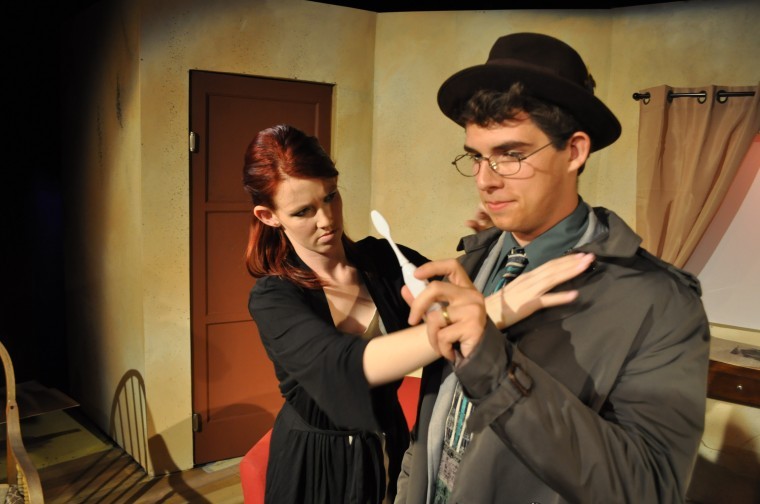
The art direction of a play can vary from something spectacular and opulent to a bare stage, but it’s rare that the stage itself is one of the most fascinating parts of a production. In “How the Other Half Loves,” the Del Rey Players’ newest show currently on stage in the Del Rey Theatre, the set is not only crucial, but it keeps the pace lively and stages the characters against each other in a unique and fascinating fashion.

While the staging is fantastic, the show is more than just its set. Hilarious, lived-in performances and a sharp pace make this show an impressive feat and a thrill to experience. Director Joe Hospodor, a junior theatre arts major, has achieved a trifecta of able direction, great set design and universally strong performances to create a portrait of domestic life that doesn’t sacrifice the humanity of its characters in search for a laugh.

The setup is simple enough: Two couples in the early ‘70s occupy opposite sides of the wealth spectrum. Frank and Fiona Foster (freshman theatre arts major Ben Szymanski and sophomore theatre arts major Paulina Fricke) are comfortable; Bob and Teresa Phillips (senior theatre arts and political science double major Rechard Francois and sophomore theatre arts major Mackenzie Ward) are less than wealthy. The primary conflict comes from Fiona and Bob’s off-stage affair and the troubles in the Phillips’ marriage.

From that central point, countless misunderstandings and awkward confrontations spur the action, and a third couple, William and Mary Detweiler (sophomore theatre arts major Kent Jenkins and senior theatre arts major Ashley Donnert) are thrown into the fray to further complicate matters. The play itself, written by playwright Alan Ayckbourn, is cute, but hinges so much on the characterization and the actors’ timing to sell the comedy.

On that front, the cast delivers in droves. This sextet of performances deserves a place in the (sadly non-existent) LMU Theatre Arts Hall of Fame – truly, this is an ensemble without weak points. As the Phillips, Francois and Ward strike the perfect balance of hate/love chemistry. Ward’s drunk and angry wife could have easily become unlikable and ventured into ‘shrill harpy’ territory, but she stays hilarious and never lets you forget that she’s truly the victim in the messy web of relationships.

Jenkins and Donnert should be given the greatest of ovations for their pitch-perfect performances as the Detweilers. From first entrance to the crucial dinner scene, where they have to essentially act in two scenes at once, the pair is flawless. Jenkins has appeared in several productions during his two years at LMU, but no director before Hospodor has harnessed his lovable, dork energy anywhere near as effectively. Donnert steals every scene she’s in, playing Mary as a meek mouse who always seems to want a way out of the crisis.

Fricke and Szymanski have arguably the hardest task of any of the actors: The Fosters are by far the most detached of any of the couples despite their picture-perfect marriage. Fiona is a particularly difficult character to make human amidst her seeming disregard for her husband and icy interactions with Teresa. However, Fricke succeeds at making her more than an alpha bitch. Szymanski is pulling nothing less than Herculean duty in selling the comedy of his character. Almost everything he does physically and with his voice when delivering a joke slays his audience. He has a gift for comedy, something Hospodor was incredibly smart to notice.

From start to finish, the production just runs like a well-oiled machine. The staging, with both main rooms on one set, allows for giant portions of the show to flow uninterrupted and keep the energy high. The costume design is clever and period appropriate, with the color choices of particular note. The lighting, while simple, does its job – there are a few dramatic moments that heighten the suspense thanks to a smart change in color or intensity.

The show isn’t perfect: The quick dialogue sometimes causes the actors to trip over their words. But the show is hardly hindered by its small flaws. In fact, it seems all the more real.

“How the Other Half Loves” is not an epic with massive sets and a veritable truckload of cast members, but it doesn’t need to be. It accomplishes so much with six skilled performers and a stage that pushes the storytelling into a new realm. Hospodor directs every aspect of the performance to the brink of perfection and often manages to push it there. It is a truly appealing production and a joy to watch.

Four showings of “How the Other Half Loves” remain this Wednesday through Saturday at 8 p.m. each night. Tickets can be bought through the Central Ticketing Agency.

Incoming seniors to live in Hannon

Originally published in the Los Angeles Loyolan. For original, please refer to: Incoming seniors to live in Hannon – Los Angeles Loyolan.

While LMU’s housing selection procedure has left some juniors and seniors lingering on the waitlist in the past, this year’s process resulted in all applicants with non-guaranteed status finding on-campus housing for the 2012-13 academic year.

The waitlist-free process, which, according to Director of Resident Services Nan Miller, is a first for the University, came with one caveat: In order to give all the non-guaranteed applicants housing, several students had to be placed in Hannon Apartments, a community that this year housed only sophomores.

“The Class of 2014, the ones who were guaranteed last year, was a big class in general. The amount of students who applied last year took up all of Hannon Apartments,” said Miller. “This year, there’s a smaller class, the Class of 2015, so there are less students in that guaranteed population.”

Seniors who are set to live in Hannon next year have mixed feelings about the situation.

“I’m not too happy about it, just because I feel like Student Housing should have told us living in sophomore housing was a possibility,” said junior liberal studies major Katherine DePonte.

“I feel like four-person junior groups would be better suited to Hannon Apartments, but for seniors, they really should be over in the Leavey area,” said junior business management major Connie Hoang.

While the presence of juniors and seniors in the Hannon Apartments may seem unusual, according to Miller it’s actually more common than some students think.

“Hannon, historically, has always been a split community in that sense,” Miller said. “Sophomores, juniors, seniors and even graduate students have lived there [previously].”

Regardless of the historical trend, the primary fear of rising seniors assigned to Hannon is that they’ll wind up living with underclassmen, an idea that is particularly unappealing to future Hannon resident and junior sociology major Melissa Mahoney.

“There’s a possibility that I’m gonna have to live with sophomores or juniors, which I’m not excited about at all,” Mahoney said. “I’ve lived with underclassmen before. It’s not fun.”

DePonte agreed, saying, “I would not be happy [living with sophomores], just because we’re in different places. We’re finishing; they’d still have two years left. I wouldn’t mind living with juniors, but I feel like sophomores are still kind of immature.”

The process of determining which buildings are available to non-guaranteed applicants is less about the upperclassmen pool and more about the number of rising sophomores.

“It’s really, in a lot of ways, focused on the guaranteed class: How many of them apply, how many of them come in. That starts to dictate how much of, let’s say, Hannon, we give to non-guaranteed students,” Miller said. “Depending on how many spaces there are in McCarthy, Rains and McKay [Residence Halls], we focus on Tenderich [Apartments] and if there are still some left, we put them in Hannon [Apartments].”

The process is confusing for several students, including Mahoney, who doubts the veracity of the selection process’s random lottery system.

“I’ve heard theories about this, that when you go to the page with the grid with the numbers, the grid is [fake],” Mahoney said. “Juniors and seniors go into the same lottery, while sophomores have their own thing. How could it be random if priority should be going to underclassmen?”

While some students may wonder about how random the process really is, Miller steadfastly defends the fairness of the program.

“[The lottery system] is absolutely, 100 percent random,” Miller said, acknowledging that many students doubt the legitimacy of the program. “It goes back to way back before any of us were here at the University when they would pull numbers out of a fishbowl. What we have online is the same philosophy, a grid put together by an expert in Information Technology Services. I don’t even know what the numbers are.”

Though some seniors may be frustrated with their housing arrangements in Hannon Apartments, Hoang and Mahoney agreed that they’d rather have the security of knowing they have housing rather than being left on a waitlist.

“If I wasn’t guaranteed housing, I’d rather just live in Hannon [Apartments],” said Mahoney. “A waitlist is too iffy. I’m not a risk taker.”

However, DePonte would rather have been waitlisted than be assigned to Hannon Apartments. “Hannon [Apartments] has always been just for sophomores,” she said, “and the environment is just very different than upperclassmen housing.”

With juniors and seniors returning in 2012-13 after a year of only sophomores in Hannon Apartments, it isn’t hard for Mahoney to imagine that Hannon itself will be significantly changed next year.

“I think that it’s going to be completely different. The fact that there’s seniors there who can go to the Loft for a bit and it won’t be a big event will change a lot of things. Hannon [Apartments] is typically for sophomores, so I think having that mix is gonna be different.”

Miller isn’t worried, however. “I don’t think it will be affected at all. The current year is the anomaly when it comes to Hannon [Apartments] predominantly being entirely sophomore students. … I know that our staff will do a great job at building the community and providing programs that meet the needs of everyone living there, just like they have in the past.”

Students must register for emergency alerts

Originally published in the Los Angeles Loyolan. For original, please refer to: Students must register for emergency alerts – Los Angeles Loyolan.

Registration for LMU’s Alert System (LMU Alert) will now be required for all students enrolled at the University in the Fall 2012 semester, according to a letter sent out Tuesday morning by Chief of Public Safety Hampton Cantrell.

The recently mandated system, which was first discussed late in the 2010-11 school year, will require students to sign up before registering for classes in the Fall 2012 semester. According to the message students received, the compulsory registration is designed “to promote safety and security.”

LMU Alert, according to Cantrell’s email, “is a system that allows the University to send important information and instructions during a campus or area-wide incident or emergency.” A system like LMU Alert for sending messages (through texts and emails) to students in case of emergency is required of all universities due to the Jeanne Clery Disclosure of Campus Security Policy and Campus Crime Statistics Act (Clery Act), which was passed in 1989.

Officials behind the change consider the greater reach of the system to be imperative. “We believe students being aware of an immediate crisis to campus is helpful to them in order to protect themselves and to keep them out of harm’s way,” said Cantrell in an interview with the Loyolan. “We have about 50 percent that are signed up now. … Right now, only half are getting the message, and that’s problematic.”

According to Senior Vice President of Administration Lynne Scarboro, the new obligatory system has been part of the plan for some time.

“We’ve been talking about it for a while,” Scarboro said. “I think that we’ve always intended it to be mandatory. It was just about thinking through how we wanted to do it.”

“This is a process that has involved people from across the University … to make sure that we are taking into account everybody’s interests in terms of the departments and the students,” said Director of Emergency Management Devra Schwartz.

“I think it’s a good idea,” said sophomore Spanish and sociology double major Bianca Villasenor of the change. “Their number-one concern should be our safety, and I feel this system makes it easier for us to keep in contact with them and can only help us know what’s happening on campus.”

Of the decision to link the LMU Alert sign-up to class registration, Scarboro said, “There are a number of things that fall into the category of being a student here and what we’re going to require of you. … It’s our responsibility to warn you. We have to require it.” Linking the LMU Alert sign-up to class registration keeps students from registering for their classes until they sign up.

“[The hold] is really our most effective way to make sure every single student registers for LMU Alert,” Schwartz said.

LMU Alert experienced some technical difficulties in March of last year when a message indicating that an armed gunman had appeared on campus, as reported in the March 22, 2011 Loyolan article “Alert system prompts concern” by then-News Editor Laura Riparbelli. With compulsory registration about to become a reality, Scarboro stressed that the system for sending emergency messages should be much more reliable now.

“Public Safety really doubled down on their training to make sure anyone that touches that system is trained. They’ve got to have two eyes on the message if it’s sent out,” Scarboro said. “We’ve got to be able to rely on it, and we’ve got to know how to use it.”

Any technical glitches, though they may be “annoying,” as described by Scarboro, shouldn’t hamper the ultimate goal of LMU Alert – that is, students’ safety.

“In an emergency, no one is likely to save you. The biggest help you can be is to yourself, but you have to have information to save yourself,” Scarboro said. “Your action in an emergency, your best chance of surviving, is what you do. That’s what the emergency system does: It puts a tool in your hands.”

– Additional Reporting by Laura Riparbelli