ASLMU town hall connects candidates to community

Originally published in the Los Angeles Loyolan. For original, please refer to: ASLMU town hall connects candidates to community – Los Angeles Loyolan.

ASLMU

Photo Credit: ASLMU

Amidst the senatorial and presentational debates that took place last week, ASLMU hosted a smaller town hall meeting with all 23 students running for office this election cycle Wednesday night in St. Robert’s Auditorium.

The town hall featured all three presidential-vice presidential tickets and the 17 senatorial candidates answering a mixture of prepared questions and questions from the audience. The recent announcement of higher parking fees was a major topic of conversation, as were the needs for more transparency and the senatorial candidates’ lack of experience and knowledge about their job requirements.

Current Speaker of the senate and senior communication studies major Mary O’Laughlin was the first to reference the latter topic, noting that several of the candidates’ plans for changes if elected were already part of the ASLMU senate’s activities. Several candidates didn’t answer the question, while others, like sophomore accounting major Michael Curran, owned up to their lack of knowledge while pledging to do their research. After a few of the candidates’ responses, junior marketing major and presidential candidate Bryan Ruiz stepped in to defend them.

Curran was also one of three senatorial candidates asked if senators should be paid for their work, something several of the senatorial candidates weren’t even aware was part of their job description. While Curran argued they should be paid, fellow senatorial candidate and sophomore entrepreneurship major Colin O’Brien gave a more conditional answer.

“I think before we get paid, we should clear up the transparency issue,” O’Brien said, echoing several other candidates who brought up the need for more direct communication between ASLMU and the LMU student body. “Once we’ve done something that merits getting paid, we can.”

The event, which was attended by approximately 30 students, half of them somehow affiliated with ASLMU, was intended to give the candidates a way to talk more directly with the community. While candidates and current ASLMU officers alike lamented the limited attendance, the event marched on with audience members asking the candidates varied and sometimes pointed questions.

“I wish there had been more people in the audience,” current ASLMU president and senior English major Art Flores said after the event. “This was a good first showing for the candidates [though].”

“I think students are busy, but I think they are interested in ASLMU,” presidential candidate and junior political science and Spanish double major Emilio Garcia said. Garcia’s running mate, junior accounting major Laura Kramer, intended to participate via Skype from Spain, but technical issues led to Garcia representing both halves of their ticket.

Ruiz and running mate junior sociology major Vince Caserio make up one of the other presidential tickets; the third includes presidential hopeful Jennifer Mercado and vice-presidential candidate Erick Bozeman, both junior political science majors. Mercado spoke about the transparency issue after the debate had ended while simultaneously defending the senatorial candidates.

“A lot of people don’t know what ASLMU really does, and that’s a problem,” Mercado said. “[The senatorial candidates] are qualified … [though] it is unfortunate that they don’t quite know what the senate does. I’m sure they’ll go home tonight and study up.”

While most of the attendees were already members of ASLMU, as noted by incumbent senatorial candidate and freshman biology major Roy Dilekoglu, there were some attendees who had no relation to the organization or any of the candidates, including sophomore political science major Ted Guerrero.

“I didn’t go to the event last year, so I wanted to show up and support, as well as be informed,” Guerrero said of his decision to attend. “I thought it went well. I thought they conveyed their passions well.”

For the senatorial candidates, the town hall was their final public event before voting next Tuesday through Thursday. The presidential candidates also appeared during Thursday’s presidential debate in Lawton Plaza.
The Bacchae of Euripides

Strong performances carry difficult ‘Bacchae’ material

Originally published in the Los Angeles Loyolan. For orignal, please refer to: Strong performances carry difficult ‘Bacchae’ material – Los Angeles Loyolan.

The Bacchae of Euripides

Photo Credit: Devin Sixt | The Los Angeles Loyolan

It can be said that “The Bacchae of Euripides,” the newest production by LMU’s theatre arts and dance department, is a strange show. It is an intense show. It is a challenging show. But most importantly, it is a masterful show.

Based on “The Bacchae,” a Greek tragedy written by Euripides, and first performed in 405 BC this version, written by the President’s Marymount Institute Professor in Residence Wole Soyinka, is an African interpretation with powerful musical moments. It requires incredible levels of commitment from each member of the ensemble cast and sky-high energy levels, and under the direction of theatre arts professor Kevin Wetmore, “The Bacchae of Euripides” is a success because it achieves both.

The story is based on the myth of King Pentheus, a man who refuses to follow Dionysus, the god of wine (amongst other things). Pentheus and his mother, Agave, are both punished, as she is possessed by the same bloodlust and passion as Dionysus’ other female followers. Behind the basic plot are greater themes, including the battle between creation and oppression. This production communicates these themes through commanding dance and music.

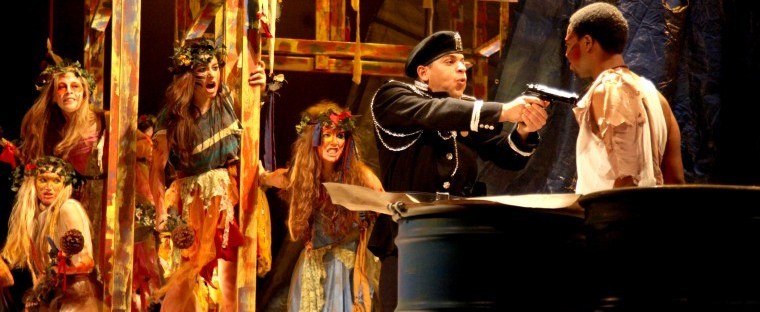
Wetmore chose to create a sense of controlled chaos in the production, with modern and classical sensibilities merging in powerful fashion. The set, designed by theatre arts professor Maureen Weiss, is absolutely incredible, almost a jungle gym on a sparse stage that is used as setting, prop and musical instrument. Every inch of the stage is used, with actors venturing into the audience for even further exploration of the space. The costumes, which were created by visiting theatre arts professor Sara Ryung Clement, are an interesting mix of African and post-apocalyptic design, a fascinating choice and one that works really well.

While the play is incredibly visually appealing, it could only reach truly masterful status with the help of a strong, committed ensemble of actors. The dialogue is challenging and the choreography demanding, so both require nothing less than top-notch work from all involved. Luckily, there are only a few weak links here – almost every performer does stunning work. Sophomore theatre arts major Julian Garcia is especially stunning as King Pentheus. From his first line, he commands attention and owns the stage with volume and authority. His range is awe-inspiring and his sheer skill is impressive.

Many other members of the ensemble join Garcia in energetic and expressive work. Two that stand out are senior theatre arts major Jeremy Larrere as Tiresias, the blind priest, and freshman theatre arts major Keeley Miller as Agave. Larrere fully inhabits his character, playing not only the dramatic moments but also making the awkward attempts at humor bearable. Miller’s Agave is all about the drama and is something of a one-scene wonder, only appearing during the play’s final moments. But the revelation of her character’s actions is ambitious and impressive.

Several members of the ensemble are given powerful monologues that rarely slow the pace of the show – instead they act as showcases for each performer, even those in otherwise minor roles. Freshman theatre arts and communication studies double major Gabriel Gonzalvez truly wrings every dramatic drop out of his monologue, breaking out of the simple Officer role and making an impact. Junior theatre arts major Nelia Miller gets multiple monologues as the leader of the slaves and knocks each and every one out of the park.

“The Bacchae of Euripides” is not without its faults, however. As mentioned previously, there are several incredibly lowbrow stabs at humor that fall short, especially considering the powerful scenes surrounding them. Why the otherwise devastatingly potent production chose to dilute the drama with painfully unfunny penis jokes and men in drag is beyond me. Additionally, there are several scenes of both the comic and tragic variety that seemed to last forever, affecting the pacing of the show negatively. This production is at its best when it is fast-moving and there’s plenty going on – watching one actor lecture another for 10 minutes is nothing but a hindrance.

Those scenes and choices, though unfortunate, cannot derail what is ultimately a brilliant production. “The Bacchae of Euripides” is more than just a play. It is art in motion with commanding performances by committed actors. It is not to be missed.

“The Bacchae of Euripedes” is now in the middle of its run at Strub Theatre. It has three shows remaining, starting with tonight’s performance, at 8 p.m. Tickets are $10.

University reacts to city’s new trash plan

Originally published in the Los Angeles Loyolan. For original, please refer to: University reacts to city’s new trash plan – Los Angeles Loyolan.

The city of Los Angeles is currently considering a new garbage disposal plan that would see the hauling of all waste performed by a single, assigned private contractor. The plan, which is purported to be an instrumental step in reaching the “zero waste” output goal, is generating controversy due to its potential to shut down smaller contractors.

While officials supporting the plan argue that the greater L.A. area would likely see a major boost in the amount of waste recycled if the plan was implemented, LMU would likely be only minimally affected by the change due to its current emphasis on recycling. The University has already chosen to oppose the measure due to the potential dip in quality of services such a plan would provide.

“The University feels like the franchise system will limit our free market choices when it comes to solid waste hauling at the University,” said Bill Stonecypher, the manager of the Solid Waste Management and Recycling departments at LMU.

Student and faculty members, however, don’t see the plan as being quite as harmful.

“It probably won’t affect us,” said environmental science professor Dr. John Dorsey. “If anything, it’ll probably be better, because more of what we put in the waste stream will be recycled.”

Junior urban studies and Spanish double major Natalie Hernandez, who works as a sustainability outreach coordinator with Green LMU, agrees that the plan will have minimal impact on the University.

“LMU already recycles a lot of its waste, so I feel like it wouldn’t affect our recycling efforts too much,” said Hernandez. “It might just affect how much waste is hauled from here.”

The plan, according to the Feb. 12 Daily News article “L.A.’s new trash plan: better for recycling or a big mess?”, will allow for greater control of recycling and could lead to unionization of workers in the sanitation field.

“I think it has a lot of potential,” Hernandez said of the initiative. “It will hold the [garbage collection] companies more accountable in their recycling efforts.”

However, Stonecypher disagrees, stating that while the zero waste goal can be achieved under this new plan, “we think the goals of that policy can be achieved through a variety of other methods that don’t include limiting a customer’s options.”

“By taking away choices, the answers to disposal issues as we strive to become even greener can only come from a single source,” he said. “Currently, the solid waste hauling industry in the greater Los Angeles area is exploding with all these new customer options … for greener solutions, and we think this should be encouraged and flowered, not hindered.”

The additional controversy around the plan arises from the requirement of only one collection company to service each of the 11 distinct regions in L.A., meaning most smaller agencies would be put under immediate threat of being shut down, thus creating a monopoly.

“We feel like the quality of services rendered by a disposal contractor in a regional monopoly would significantly degrade the quality of service,” Stonecypher said.

“Sure, it could definitely do that,” Dorsey said of the possibility of a monopoly. “Everyone needs their fair shake. But even the smaller groups have said that they need to do a better job of recycling.”

The new plan could also potentially raise disposal prices for the University and for the greater L.A. area.

“According to the city’s own data, consumers pay almost 33 percent higher rates in exclusive franchised cities,” Stonecypher said. “And that’s really tough for us in this time of fiscal crisis because we’re doing everything possible to keep our infrastructure costs down so we can keep tuition down.”

Currently, LMU recycles 56 percent of its waste output, according to the Recycling and Waste Management information section on the University’s website. LMU has been recycling since 1990, reaching state mandates for increasing the reuse of discarded materials a full five years ahead of the deadline at the turn of the millennium.

“But LMU needs to continue working on reducing our overall waste stream by cutting down on what we throw away, what we reuse,” Dorsey said.

Debate over the new garbage transfer initiative began in City Hall this past Monday and will continue until the measure reaches a vote. If approved, the new program wouldn’t be implemented fully until 2016.

Crucible

Review: ‘The Crucible’ favors volume over subtlety

Originally published in the Los Angeles Loyolan. For original, please refer to: Review: ‘The Crucible’ favors volume over subtlety – Los Angeles Loyolan.

Crucible

Photo Credit: Justin Lai | The Los Angeles Loyolan

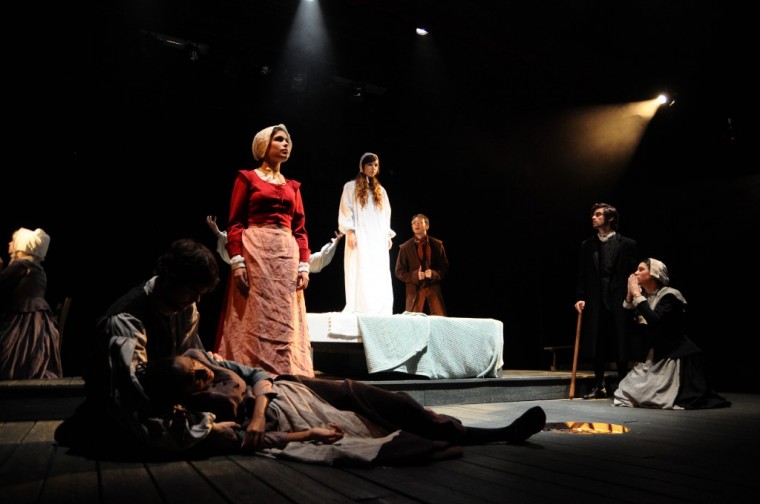
LMU’s theatre arts and dance department is currently in the middle of their run of “The Crucible,”Arthur Miller’s iconic play about the Salem witch trials. Written as an allegory for the ongoing Red Scare and the accusations of communism among Americans in hearings held by Senator Joe McCarthy, “The Crucible” is a staple of many English and theater departments in high schools and universities across the country.

The production, directed by Professor Nenad Pervan, is committed to wringing out every last moment of drama in the script, but does so in a heavy-handed manner that leaves the audience cold and tired after the cast has taken their final bow.

Throughout the performance, my one desire was to find a volume knob and twist it sharply downwards. If there were a knob for intensity, I would do the same. The whole show is simply over-the-top and overly long. At any point where there was a choice of loud versus soft or big versus small, Pervan seems to have chosen the bold, the brash and the bothersome.

Attempting to milk every moment of drama may have a temporary impact (scaring the audience into awe), but it comes at a serious cost. At least one major scene holds absolutely no power because it bears too much resemblance to all the other scenes preceding it: a lot of yelling and a lot of anger. It overdoses to the point where the supposed power scenes hold no power at all.

One particularly ill-advised scene comes near the end, which involves scare tactics and loud screaming. It simply doesn’t fit with the rest of the show and seems to have been thrown in just for the shock value. It shocks, yes, but it also annoys and colored my opinion of the production negatively.

This is obviously a talented cast with plenty of potential, yet most of it isn’t being used properly. Many of the female actors understand when to play up the drama and tone it down in ways their male counterparts don’t seem to understand. Emily Ludlow, a freshman theatre arts major, is particularly good, showing impressive range. Ludlow is aware that her character, Abigail Williams, is the clear antagonist, but she never attempts to gain the audience’s love in a way that would compromise the character.

Maddy Haderlein, a senior theatre arts major, plays cold incredibly well as Elizabeth Proctor, providing a strong counterpart to scene partner and fellow senior theatre arts major Devin Kasper. She, like Ludlow, never tries too hard to impress or dramatize. Elena Muslar, also a senior theatre arts major, isn’t given too much to do as Tituba, but she’s a highlight whenever she’s on stage. She isn’t afraid of being melodramatic, but she also knows how to avoid going overboard.

Several of the male actors do well in their roles: special kudos go to senior theatre arts major Jesse D. Arrow as Giles Corey, an absolute high-water mark. He’s incredibly fun and a breath of fresh air. But on the whole, the men are either underperforming (senior theatre arts major Connor Smith’s Thomas Putnam sounds a little sleepy) or doing nothing but ranting, raving and scene chewing. Part of this is the responsibility of the actors, but most of the fault falls on the director who didn’t guide them on how to better utilize their skills.

Special attention must be paid to the costuming by Gwynne Clark. The period detail is done to near perfection, with Abigail’s stark red outfit (signifying the great lust her character has buried deep within her) being a highlight. And the lighting, designed by Dan Washington, is impressive but at times overwhelming – one wishes the action onstage would be quieter so the truly superb lighting could be the star of the show.

It should be said that “The Crucible” has many wonderful elements to it that should draw you to the theater, but don’t be surprised if you’re left overwhelmed and unsatisfied. A good production has a lot of good elements. A great production utilizes those elements and brings them together in a really appealing, remarkable fashion. By that principle, “The Crucible” is a good production. But it is not a great one.

John West

A chat with John West

Originally published in the Los Angeles Loyolan. For orignal, please refer to: A chat with John West – Los Angeles Loyolan.

John West

Photo Credit: The Concert Agency

Fresh from being signed to Mercury Records, John West is setting the electronic world on fire with his warm, familiar acoustic sound. The artist, who is appearing with Tamar this Wednesday at the Living Room, took time to talk to the Loyolan about loving his audiences, his dream collaborations and covering a Rihanna hit.

Kevin O’Keeffe: How did you come to play at LMU’s “Live in the Living Room” venue?

John West: I had a friend who does some college bookings. He lined this up as well, since it was in L.A. But I don’t go too deep with the LMU scene, since I never went there or anything.

KO: Did you know of Tamar, your fellow artist at this concert, previously?

JW: I haven’t specifically met her, but I look forward to meeting her.

KO: On the topic of other artists, I have to ask: Who would be your dream collaborator?

JW: I’ve just gotten a deal with Mercury Records, so I’ve gotten the chance to work with some really great producers. Just yesterday, I got the chance to work with Bruno Mars’ camp, so I really look forward to getting to work with him. There are a lot of great people out right now, like Kanye West or Drake. Alicia Keys, too.

KO: You’re well-known for your interaction with the audience during a live performance. How do you adapt that to this college campus setting?

JW: The way I’ve built my fan base and my live performance technique, I’ve played on the streets as a performer. To some degree, when I play a room of people who aren’t going to walk past you a couple seconds later, it definitely takes the edge off. You’re always playing in front of strangers, but I don’t know. I don’t take it too seriously. It’s about having fun onstage and making sure the people around you are having fun too.

KO: What is the experience you want your fans to take away with them after a concert?

JW: The Dalai Lama has a great quote that’s something like, “I don’t want to be just inspiring; I want to be awe-inspiring.” If I can inspire people in a crowd, that’s the dream experience I would want them to take away from a concert of mine, whether their dream is being a musician or being the first in the family to get a college degree, anything.

KO: You’re also known for your acoustic cover of Rihanna’s “Umbrella.” What was your inspiration to take such a well-known song and turn it on its head?

JW: I just liked it a lot; it was such a great song. It’s what I like to call “dark pop”. When you cover a song, you definitely have a style that comes through whatever song you’re paying homage to. Sort of my spin on it, I was playing it how I felt it, which was a little slower and more focus on the lyrics.

KO: Would you say the tone and style of the “Umbrella” cover meshes well with your usual musical style?

JW: Yeah, I think my newer stuff is more up-tempo. Everything has sort of a laid-back feel, but yeah, I think it definitely fits.

KO: What do you think of being a recording artist in today’s constantly changing media world?

JW: It’s been challenging for an artist for the past 30 or 40 years because pop music is constantly evolving. Who’s the biggest artist in the world? Probably Lady Gaga, and similarly, everyone’s into these big dance songs. As an artist, the question is, do you attempt to fit that mold, or do you press on doing your own thing?

KO: But what specifically about today’s media makes it either more or less difficult?

JW: As a recording artist in 2006, you were probably in a rougher spot with the labels, so unaware of where things were going in media. But now, downloads and ringtones are just as important as selling records, and 100,000 records is a major hit now. For me, even without a record label, I’ve been able to be self-sufficient. I just think there’s a lot more power in an independent artist’s hands.