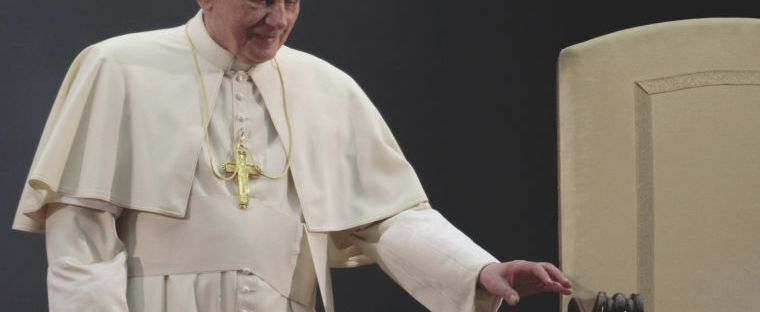
Pope’s resignation: Opportunity for change

Photo Credit: Associated Press

Photo Credit: Associated Press

Originally published in the Los Angeles Loyolan. For original, please refer to: Pope’s resignation: Opportunity for change– Los Angeles Loyolan.

Change can be a good thing, but how can you say that when the supposed reason for the change is anything but good?

It’s pretty grim to celebrate someone’s allegedly poor health, but Monday’s announcement that Pope Benedict XVI is stepping down from his position – the first such resignation in almost 600 years, according to the article “University reacts to the Pope’s resignation” appearing on Page 1 of this issue – isn’t what I’d call “bad news.”

It’s the perfect time for major transition and progression for the often socially conservative Roman Catholic Church, which is, in my opinion, quickly losing touch with young people like myself. Many in my demographic were baptized Catholic, myself included, but quickly became disillusioned with the Church’s outmoded teachings on the role of women in the church and, especially in my case, homosexuality.

The former Cardinal Joseph Ratzinger took his place as the head of the Church in 2005 after the death of Pope John Paul II, and since then has managed to remain frighteningly stagnant on social issues, particularly about gay men and women and their relationship to the Church. As recently as last Christmas, according to theHuffington Post article “Pope Benedict Takes Anti-Gay Marriage To New Level In Christmas Speech On Family Values,” Pope Benedict XVI called homosexuality a “manipulation of nature.”

“People dispute the idea that they have a nature, given to them by their bodily identity, that serves as a defining element of the human being,” Pope Benedict XVI continued. “They deny their nature and decide that it is not something previously given to them, but that they make it for themselves.”

For the patriarch of a multinational organization to say something so startlingly archaic is, in my opinion, a sign that the Church itself is completely behind the times for most of the Western world. Additionally, there’s Pope Benedict XVI’s inactivity in properly responding to the Church’s sex abuse scandals. According to the Guardian article “Pope Benedict ‘complicit in child sex abuse scandals’, say victims’ groups,” the Survivors’ Network of those Abused by Priests (SNAP) considers the pope’s lack of transparency about sexual abuse by clergymen to be “terrible.”

The general accusation against Pope Benedict XVI, according to the same article, is that despite his knowledge of clerical sex abuses, he has, for the most part, done little to respond to them. As the article quotes SNAP Executive Director David Clohessy as saying, “He knows more about clergy sex crimes and cover-ups than anyone else in the Church, yet he has done precious little to protect children.”

Though all the details in those cases are still being scrutinized, there’s no doubt in my mind that it is all yet another sign that the Catholic Church needs to become more progressive and more transparent. While the Catholic Church is proud of its traditions, they won’t mean much if membership in the Church dwindles – and according to the Slate article “He Didn’t Finish What He Started,” that’s exactly what’s happening.

In my opinion, the Church is in a position to make the biggest sweeping reform since the Second Vatican Council started in 1962. Vatican II changed the spoken language of the Mass from Latin to a colloquial tongue as part of an attempt to make the Church less imposing and more a part of traditional family life. However, it could be argued (as the aformentioned Slate article does) that it wasn’t enough to keep younger people involved. A more drastic shift in the Church could occur should a more progressive figure become pope, wherein things like homosexuality would be brought into a more contemporary context.

However, I’d bet that’s not going to happen. In January of this year, according to the Reuters article “Pope Benedict names new cardinals who’ll choose successor, mostly Europeans,” the retiring patriarch named an additional 18 conservative European cardinals who will participate in the papal election process. This decision raised the number of Europeans among the 125 cardinal electors to 67. This means that instead of a more diverse choice from another continent, we’re likely to see yet another conservative European.

Still, if I could implore the Catholic Church to do one thing, it would be this: Consider Pope Benedict XVI’s resignation as an opportunity to appoint someone new and different. Progress as an organization. Move beyond where you were and into present day.

The Church is quickly losing touch with our generation, and things aren’t going to get any better if the next pope stays the course. This is a changing world, and now is the time to move along with it.


A different kind of Valentine

Originally published in the Los Angeles Loyolan. For original, please refer to: A different kind of Valentine – Los Angeles Loyolan.

Having a tough time finding that ‘perfect someone’ this Valentine’s Day? Bored with the ‘same old same old’? Do you feel like the opposite sex just isn’t cutting it anymore?

This Valentine’s Day, I challenge all straight-identifying, single Lions to try something new: experiment with the same sex. Sure, you may have never thought about it before, and it might not be your cup of tea. But maybe, just maybe, the idea has been there for a while, gestating in the back of your mind. You might be a lady harboring a girl crush on Mila Kunis. Or, maybe you’re a bro who secretly loves Ryan Gosling movies – or just Ryan Gosling.

Regardless of your past relationships, there’s no better time than now to shed your inhibitions and give experimentation a shot. Here are my top tips for all you single ladies and gents who are just a little bi-curious.

1. Don’t restrict yourself to experimenting at LMU.

Take it from a guy who’s attempted to date among the approximately six openly gay men on our little campus: You’re better off away from the bluff. If you’re of drinking age, heading to the bars around UCLA and USC can reap some long-term rewards.

Then again, if you’re bar hopping and only queer for the evening, why on earth are you wasting your time anywhere besides West Hollywood? Eleven, Micky’s and Gym Sportsbar are all distinctly different but great bars with different styles, meaning curious guys will be able to survey several different flavors of dude.

Ladies, your bar options are unfortunately slimmer, but you can try out the Palms Bar for an all-lesbian experience. Then again, girls can also go to pretty much any non-gay bar and find at least a dozen drunk women looking to get Sapphic. Y’all will be fine.

2. Master the eye language.

Despite what you might think, not every homosexual is trying to get into your pants. So, you’ll have to learn the lingo, but lucky for you, it’s all in the eyes.

Ladies, I unfortunately can’t speak to this as well for you as I can for men, but the biggest tip I can give is to never approach someone before locking eyes across the room. Why? It’s actually universal to all sexualities: Think about if someone you weren’t interested in was trying to make eye contact with you. What would you do? That’s right, you’d turn away. So, if the eye contact sticks, that’s your signal to dive in. Don’t worry about the chase – if you’ve kept up eye contact, he or she is definitely interested. Go for the gold.

3. Above all else, have an open mind.

Like I said, experimenting isn’t for everyone. Some people just aren’t into it. For others, it requires an openness that can be difficult to muster. But if you’re interested in trying things out, make sure to really commit to it. Flirt it up and have a good time. Worst-case scenario, you wake up in the morning and think, “Well, never doing that again.” At least you tried something different. And maybe, just maybe, you wake up with the number of someone wonderful you might never have expected to date. That’s the kind of dream most people would kill for on Valentine’s Day.

Greek Week shifts focus to interfraternalism

Originally published in the Los Angeles Loyolan. For original, please refer to: Greek Week shifts focus to interfraternalism.

Greek Week

Photo Credit: Leslie Irwin | Loyolan

Before this year’s Greek Week commenced, community anticipation for the upcoming celebration of Greek Life was struggling to overcome mixed feelings regarding changes to the week’s structure.

“In the beginning, everybody was pretty concerned,” said senior psychology major Lisa Flanigan, president of Kappa Alpha Theta. “For a while, when we didn’t have anything figured out and we didn’t really have ideas of how to make Greek Week work … it was a subject that didn’t really go over well.”

Junior political science major Michael Hanover, president of Sigma Phi Epsilon, agreed, calling the community’s response “between negative and [mixed]” before the week began.

“The idea behind the changes … [was] building a certain level of respect that, according to some, has been absent in past years between organizations. I believe, wholly and truly, that the changes were motivated by the right sentiment,” said Hanover. “The reaction has fallen off from that complete level of positivity.”

“Change is never easy,” said Assistant Director of Student Leadership and Development and Greek Adviser Dan Faill. “But I truly feel it was the best move … and I was pleased at the overall reaction from chapters to combine into larger teams for Greek Week, an idea that was brought forward from chapter presidents at the fall Greek retreat.”

Said conglomeration has paired one fraternity, one sorority and one “multicultural chapter” in each team, according to Faill. This plan was met with enthusiasm from some individual organizations, especially Sigma Lambda Gamma, according to Chapter President Nina Garofalo, a senior English major.

“We felt we weren’t included in the camaraderie of Greek Week, and so [the new system] gives us an opportunity to make friends and not be so competitive about it,” Garofalo said. “We’re already so proud to wear our letters, so we don’t feel like we need to prove ourselves.”

This interfraternal pride was purposefully designed as one of the overarching goals of Greek Week, according to Co-Vice President of Greek Week Sean Daly, a senior communication studies and theatre arts double major.

In addition to the conglomerate teams, the other major change was the separation of Greek Week from Lip Sync and Stroll Off, according to Co-Vice President of Greek Week and junior psychology major Penney Azizi. Lip Sync and Stroll Off, once the culminating event of Greek Week, was moved to early September this year due to scheduling conflicts in booking Gersten Pavilion.

“Certainly, Lip Sync was a great way to cap it off, but was there anything that the Greek Week VPs could have done about that?” said Hanover. “According to what they’ve said, I don’t think so, and I trust them on that.”

Substituting for Lip Sync will be the All-Greek Masquerade Ball, a formal event on Saturday in Burns Back Court, where winners of the week will be announced.

Other changes included a redesigned football tournament with only one day instead of two, and a restructured obstacle course that involves more team members and a chariot race leg, according to multiple sources.

While final judgment on the week’s redesign has yet to be rendered, before it even began, individuals from within the community had disparate reactions to the week’s true meaning.

“I really appreciate all the work they’ve put into this Greek Week and making it more interfraternal, really trying to bridge those gaps,” Garofalo said.

“It’s all about being Greek, not necessarily about what letters you wear, and the community as a whole,” Azizi said, echoing Garofalo’s sentiments about inter-fraternalism.

Flanigan, however, emphasized personal chapters saying, “I think it’s positive, because you’ll still have your own pride for your own organization.” But, she added that through Greek Week, individual chapters would be “breaking down the barriers between different organizations.”

Hanover said in summary, “On the one hand, any … time of change brings about some strife from somewhere or another in the community. On the other side of it … to make big changes like that, you have to be bold to do that, and if you go there you’re gonna make some mistakes too. You can’t make big changes like that and expect that it’s gonna please everybody.”

Greek groups reflect on probation

Originally published in the Los Angeles Loyolan. For original, please refer to: Greek groups reflect on probation – Los Angeles Loyolan.

Three Greek organizations have recently come off social probation, while a fourth remains on probation indefinitely.

Lambda Chi Alpha, Sigma Chi and Sigma Phi Epsilon fraternities were on probation from the beginning of the academic year until the first of this month, according to junior political science major Michael Hanover, Sigma Phi Epsilon’s chapter president.

According to sophomore political science major Alex Petosa, a member of Alpha Phi sorority, these suspensions came about because of the same event last semester that put Delta Gamma sorority on a still-continuing social probation.

“It was an event involving the introduction of new Delta Gammas to members of fraternities,” Hanover confirmed. “As far as I know, somebody got sick [for alcohol related reasons] and everybody there was held accountable.”

In a statement released to the Loyolan through Chapter President Libby de Leon, a senior history and screenwriting double major, Delta Gamma confirmed that their chapter did indeed receive sanctions from the University and the national Delta Gamma Fraternity for “behavior that did not align with our mission.”

The organizations were held accountable in a process outlined in LMU’s Community Standards, according to Assistant Director of Student Leadership and Development and Greek Adviser Dan Faill.

“In any organization, as with being human in general, people make mistakes,” Faill wrote in an email to the Loyolan. “If people make mistakes at organization-related activities, the organizations will be held accountable. … It’s my job to ensure a safe and fun Greek experience; sometimes that comes with holding sorority [and] fraternity members and organizations to a higher standard.”

“Traditionally, if you look at any other school, everyone does that kind of stuff,” Petosa said regarding the difference between LMU and other universities’ Greek life. “It’s a conflict between LMU’s ideals and what Greek Life is. … We go to a Jesuit university, and so Greek Council and Dan Faill have a standard to uphold. And they have to uphold the school’s mission statement.”

According to senior psychology major Lisa Flanigan, president of Kappa Alpha Theta, Delta Gamma remains on probation.

“They were definitely put up as an example,” Petosa said of Delta Gamma’s longer probation. “I think it’s the historical example that no one’s perfect. … It’s just too bad it had to happen. … They had to be upheld as an example. They violated the rules, and rules are rules. That’s in LMU’s standards.”

As part of the probations, each chapter was delivered sanctions by the University’s Judicial Affairs department. For Sigma Phi Epsilon, the sanctions included “education on risk management, how to conduct safe events and not make stupid mistakes,” according to Hanover. The organization was also prohibited from hosting any events with alcohol.

“I think that the sanctions that were levied upon us were very reasonable and educational,” Hanover said. “They were all directed towards teaching us how to keep our members safe and conduct themselves in a way that was more healthy and conducive to development in the future.”

The terms behind social probations are determined on a case-by-case basis. According to Faill, they depend on the group and any alleged violations.

Just three semesters ago, Kappa Alpha Theta was placed on social probation as well.

“We had an event where girls were drinking alcohol on campus. It was a dry event,” Flanigan said. “The school found bottles of alcohol … in a bathroom.”

Like Delta Gamma, Kappa Alpha Theta received sanctions not only through the University, but also through the national organization. According to Flanigan, her chapter had a number of sanctions levied upon it.

“I don’t remember everything that we had to do – we did a bunch of things – but one of the things that we did recently for LMU was an educational program for the LMU community about drinking and driving,” Flanigan explained. The program involved bringing a smashed car from Mothers Against Drunk Driving (MADD). Additionally, Kappa Alpha Theta held a service day for workers at LMU.

Kappa Alpha Theta’s probation wound up lasting for a semester, something that Flanigan said is not common. The time was spent bonding as a chapter and making up for their mistakes.

“We always say that we think being on probation really helped our organization become even better, because we were able to take a step back and look at our true values and morals of our organization, where we were and where we needed to be,” said Flanigan.

In its statement, Delta Gamma echoed that sentiment, saying that its chapter is “appreciative for the learning opportunity and [we] look forward to continuing to work with the University and various groups on campus to build awareness about safety, risk management and social responsibility.”

“I think this whole thing was a culture shock for us. We got to see how things could go wrong,” Hanover said of the fallout from the probations. “I think the whole community learned a lesson from this.”

When asked what advice she would give current organizations on or coming off probation, Flanigan said, “I think that it’s really important to take a step back and look at why you’re in this organization, why all you girls or boys … are in an organization that has certain values and why you joined that organization over others.”

She added, “You have to make the most out of it.”

Two-party debate: An exercise in futility

Originally published in the Los Angeles Loyolan. For original, please refer to: Two-party debate: An exercise in futility – Los Angeles Loyolan.

Two-party debate

Cartoon Credit: Jackson Turcotte | The Los Angeles Loyolan

By all accounts, Tuesday night’s second U.S. presidential debate was an exciting affair. President Barack Obama showed he had some serious fight left in him. Republican candidate Mitt Romney didn’t back down. Moderator and CNN journalist Candy Crowley did what so many of us have been dying to do and fact-checked Romney on air. Compared to Romney’s dull-as-dirt total knockout in the first debate, this one was absolutely fascinating.

So why am I so unsatisfied?

From an unbiased standpoint, the debate was grand political theatre; at points, it honestly looked like the two candidates were a moment away from coming to blows. However, I’m not an unbiased observer. As an American citizen, a college student who hopes to get a job someday and a gay man who hopes to get married someday, I’m very much biased towards specific agendas, and I care about who wins this election. From that perspective, all the debates have been a bunch of, to borrow a phrase from Vice President Joe Biden, “malarkey.”

This isn’t entirely the fault of the candidates, though. It’s more the fault of the two-party debate format that makes every political battle “he said, he said.” Except for the rare moments when a moderator intervenes (Crowley’s aforementioned fact-check, ABC News’ Martha Raddatz’ relatively aggressive moderation in the Vice Presidential Debate), most of the time, viewers are left to infer whether one candidate or the other is being honest. (That is, of course, something that didn’t used to be an issue when lying in a debate wasn’t so rampant and unapologetic, as Romney has proven to be so far. So remember, it’s still kind of the candidates’ fault.)

While I don’t like the two-party format, I don’t particularly like bringing in a third-party candidate either. What’s so theoretically great about a two-party system is that the extremes are represented, and great debate can spring from the differences. Obviously, that hasn’t happened so far. Like I said, theoretically.

What the debates need is a real-time, fact-checking system. Again, theoretically, the moderator should do this, but between Jim Lehrer’s poor performance as moderator in the first debate and the ridiculous rules the campaigns unsuccessfully tried to enforce on Crowley in the second, the moderator is clearly not serving this function. Under pressure of being fact-checked, the candidates would have to provide real answers, hopefully creating some real discussion and showing the differences in their platforms. In that model, undecided voters could make an informed decision about how to vote. Additionally, policy wonks would be able to hear a real discussion about issues. Imagine that.

While political theatre is great, ultimately it is nothing more than smoke and mirrors, and I, for one, think the very biased observers – the American people – deserve a true debate.

Forgive me if I’m not holding out too much hope, though.