Don’t hate the “8”

Originally published in the Los Angeles Loyolan. For original, please refer to: Should “8” play?: Don’t hate the “8” – Los Angeles Loyolan.

Graphic Credit: Alberto Gonzalez | The Los Angeles Loyolan

It shouldn’t even be a debate.

I’ll admit – I’m curious as to what fellow contributor Lauren Rockwell’s argument is regarding the LGBT Student Services (LGBTSS) Office’s presentation of “8,” the pro-marriage equality play, at LMU tomorrow night. From my point of view, not as an LGBT individual, nor as someone who is pro-marriage equality, but simply as an LMU student, I fail to see a single valid reason why the play shouldn’t be read on our campus.

Agree or disagree with what the play is arguing, the fact is that the show must go on, not because of the subject matter, but because it is an expression of a faction of students’ opinions. Their voices deserve to be heard.

For those who aren’t familiar with the play, “8” is a dramatic interpretation of the Perry v. Schwarzenegger trial currently headed for the Supreme Court. The case is about the constitutionality of Proposition 8, the infamous amendment to the California constitution that banned same-sex marriage in the state. Written by Dustin Lance Black, the Academy Award-winning screenwriter of “Milk,” “8” is an unabashedly biased and activist look at the trial, but it never pretends to be anything else.

Controversy brewed about the presentation of “8” on LMU’s campus when The Cardinal Newman Society posted an article about this on its blog. The post, which has been picked up by a couple other Catholic blogs but has failed to make a dent in the greater media sphere, argues that LMU is promoting gay “marriage” (complete with incredibly condescending quotation marks) through its production of “8.”

What The Cardinal Newman Society fails to understand is that if LMU were to shut down the production of “8,” the University would be silencing student voices simply because they are at odds with the Catholic Church’s positions – a terrifying proposition, and completely at odds with the Jesuit mission to educate the whole person and encourage learning, as LMU’s mission statement reads.

When asked about “8” in an interview with the Loyolan, ASLMU President Bryan Ruiz said that he believes LMU students’ self-expression “does need to be heard.” LMU and President David Burcham are clearly working with the same mindset, and their refusal to cancel the show is inspiring.

I’m incredibly proud to go to a religiously-affiliated school that is comfortable presenting a pro-marriage equality play on its campus while not fully endorsing it. To endorse the show would indeed be a violation of the Catholic position, something we shouldn’t ask the University to do. But to shut it down would violate our mission. So in truth, President Burcham and his administration have done the only thing they can do without appearing hypocritical to some part of the University’s identity.

You’ll notice I haven’t talked much about why I think “8” is so great and how important the message it will spread to students is. That’s because “8” isn’t great, and I think said important message is something the majority of our student body already supports.

On paper, “8” is a clumsily written play, full of preachy monologues and an unwillingness to portray marriage equality opponents as anything but morons. The marriage equality debate deserves a better dramatic interpretation, and I have no doubt that several years down the road, we’ll see one. But a show being bad isn’t any reason to censor it from running. As the Loyolan’s primary theatre critic for the past two years, I’ve certainly seen shows I didn’t like, but you never once heard me call for their cancellation out of sheer disgust. Besides, the point of “8” isn’t to be great theatre – it’s activist in nature.

The message it is spreading, however, is something I think most students on this campus and across the country already feel: Marriage equality is the right thing for right now. Even among young conservatives in the U.S., support for same-sex marriage is rapidly rising. A Washington Post-ABC News poll from May shows that almost half of young conservatives do indeed support marriage equality – and among young liberals, that number is sky-high. So, I don’t necessarily think a college campus, even a Jesuit one like LMU’s, is the most effective stage for a play like “8.”

What does any of this matter? Simple: It doesn’t. No matter how bad the play is, how repetitive its message may be or how much it may get The Cardinal Newman Society’s panties into a bunch, there is simply no valid reason to cancel “8.” At the end of the day, this is about students’ free expression, and we go to a school that values said expression.

That’s something worth celebrating, not debating.

Call Me Maybe - Carly Rae Jepsen

2012 pop music: 2011 redux

Originally published in the Los Angeles Loyolan. For original, please refer to: 2012 pop music: 2011 redux.

Call Me Maybe - Carly Rae Jepsen

Photo Credit: YouTube | CarlyRaeJepsenVEVO

Summer has officially ended, and the popular consensus has arrived: Frequently parodied earworm “Call Me Maybe” by Canadian artist Carly Rae Jepsen is your Song of Summer 2012. By now, you’re probably just a little tired of listening to it – which is natural for songs that you hear almost every day for a full 3½ months. But imagine how Canadians must feel – they first heard the song in September of last year.

This highlights one strange trend that emerged this year with pop music being even more behind the times than usual. Both of the most popular songs of the year – “Call Me Maybe” and Gotye’s “Somebody That I Used to Know” – were actually released in 2011, as was the highest selling album of this year, Adele’s “21.” While radio is no stranger to late-peaking hits, it is strange for the gap to be almost a full year after release.

So how did we wind up with pop music in 2012 that was nothing more than 2011 redux? With Adele’s album, we can chalk her continued successes up to being Adele, the savior of modern album sales, and write it off as an aberration. But with “Maybe” and “Somebody,” trying to explain why only leads to more questions.

Both Jepsen and Gotye are from outside the country, which might explain why their songs didn’t make it here earlier. But if that’s the case, why did they become so big anyway?

The songs aren’t exactly the electropop dance songs or ringtone hip hop we’ve come to expect of the radio, so it might have taken them longer to catch on. But if that’s the case, why did they catch on anyway?

Big pop artists like Adele, Lady Gaga and Beyoncé stayed out of the singles game this summer, choosing not to release anything to radio. Compare that to the era of monster singles like “We Found Love” and “Someone Like You” at the end of last year, and it’s easy to see that there wasn’t room for Jepsen or Gotye until this year. But this summer brought big songs from the likes of Rihanna (“Where Have You Been”), Katy Perry (“Wide Awake”) and Maroon 5 (“Payphone”), yet the two scrappy upstarts still reigned supreme.

The best explanation I can come up with is that there is no explanation – at least, no simple one. “Maybe” and “Somebody” seemed to rise to prominence independently due to the promotion from their labels and other Internet success. Whereas Jepsen had Justin Bieber and all his famous friends on her side, Gotye had Walk off the Earth’s five musicians-one guitar viral cover. The songs’ 2011 roots seemingly had nothing to do with their success – all just a coincidence. However, when you realize that the third biggest hit of the year, fun.’s “We Are Young,” was also released in September 2011, you can’t help but feel you’re missing a pattern.

Pop music is obviously cyclical, and there are always going to be transition years. I’d chalk this year up to nothing but radio programmers trying to find a new sound as the dance revival is cooling down. We’ll see more songs in the next year or so mirror the sounds that Adele, fun., Jepsen and Gotye first made popular this year.

Until then, enjoy your last remnants of summer music, including Ellie Goulding’s “Lights,” a song peaking in popularity right now that was first released in – er, 2010. Back to the drawing board.

Ryan Gosling

Post Revisited: My Letter to Ryan Gosling

Ryan Gosling

Photo Credit: Flickr Creative Commons

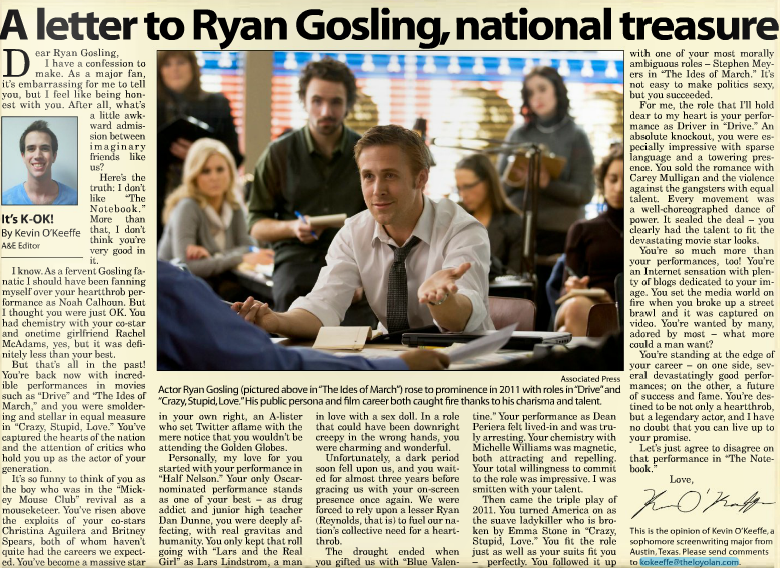
The Piece: A letter to Ryan Gosling, national treasure
Original Publication: The Los Angeles Loyolan
Date of Publication: February 2, 2012

Background: I took over as the Loyolan’s Arts & Entertainment Editor in late September, with my first solo issue coming that October. From that first issue on, I wrote a column for the section called “It’s K-OK!” Generally, the theme of the column was ‘pop culture as lifestyle,’ but I deviated from that well once or twice, to say the least. This was one of those deviations.

Conception: At the end of January, Ryan Gosling was riding a wave of good publicity. Though he had missed earning an Oscar nomination for either Drive or The Ides of March, he was gaining a reputation as the hottest young actor working today. My actorcrush on him started with Half Nelson and bloomed into full-on actorlove with Fracture and Blue Valentine. The last year was a triple play of charm (Crazy, Stupid, Love.), savvy (The Ides of March) and undeniable appeal (Drive). Ryan had sealed his place in my heart.

I was about to transition into my new position as Managing Editor and, as a result, would be writing my column much less frequently. I decided to do something different for one of my last editions, and the result was my letter to Ryan.

Letter to Ryan

Design Credit: The Los Angeles Loyolan

Execution: Part of what I loved so much about putting this together was the design. Originally meant to just run like a regular column, a co-worker and I brainstormed to come up with a presentation where the letter would appear to have been printed on parchment — including my signature at the end. I was thrilled with how it looked, and it was the first hint of something the current Arts & Entertainment Editor at the Loyolan would really run with: engaging, thoughtful page design that used appealing graphics instead of static templates.

Revisiting: Admittedly, if I had to rewrite this piece, I would have put it out in October, in the heat of Ryan’s success. With the delay of his movie Gangster Squad to 2013, this year will go without a major Gosling release, and the spotlight has been shifted to fellow Emma Stone co-star Andrew Garfield for his work in The Amazing Spider-Man. Still, I’m firmly in Ryan’s corner — he’ll be back soon enough, and in a big way. I’m just glad I got to declare my love in such a creative, fun fashion.

Southwest Airlines

Kid-free flying at 40 thousand feet

Originally published in the Los Angeles Loyolan. For original, please refer to: Kid-free flying at 40 thousand feet – Los Angeles Loyolan.

Southwest Airlines

Photo Credit: Flickr Creative Commons

When you’re flying Southwest – one of the only airlines that allows you to pick your own seat – there’s a science to making the right choice. You want to smile at the people who look quiet and courteous, cough loudly when the talkative and brash people give the chair next to you a glance and, most importantly, you want to avoid families like the plague.

Children are a terror to fly with simply because they’re not used to the experience: They’re in a new and unfamiliar environment and they aren’t quite aware enough to take the social cues that screaming or talking endlessly aren’t appropriate. This isn’t the kids’ fault (if anything, it’s the parents’), but you as a flier shouldn’t have to deal with the shenanigans. Unfortunately, if you’re not flying Southwest, your seating fate might be left to the airline gods. If you get a parent and child as your aisle mates, strap in for a bumpy ride.

If you get the chance to fly Malaysia Airlines, however, your child-filled flying days might be over. According to the April 12 CNN.com CCNGo Staff article “Malaysia Airlines launches kid-free economy zone,” the Asia-based airline’s flight from Kuala Lumpur to London, launching this summer, will have an upper deck reserved reserved seating assigned specifically for all passengers above 12 years old. All families that have younger passengers will automatically be put in seats on the lower deck.

To counteract any potential criticism over the move, the lower-deck will be revamped to be particularly family-friendly, with 350 seats – many more than the upper deck, which only has 70 seats.

CEO of Malaysia Airlines Tengku Azmi tweeted that “the carrier received ‘many’ complaints from passengers who fork out for the expensive tickets, but then can’t sleep due to crying children,” according to the April 11 Daily Mail article “Child-free flights? Malaysia Airlines bans children from upper deck of its A380s.” This sense of peace and quiet is clearly the primary motivation behind the new no-child zones, according to Shashank Nigam, the CEO of SimpliFlying, an airline branding company that specializes in customer service and engagement.

According to an April 9 MSNBC.com article titled “Malaysia Airlines offers child-free zone on new Airbus A380,” Nigam elaborated on the decision by saying: “Malaysia Airlines is trying to make its premium product on the A380 more appealing to the high-yielding business passengers. … They value their peace and quiet and [this way] can rest assured that they won’t be disturbed by kids on long-haul flights.”

I’m not exactly one to sleep on long flights, but I still love the peace and quiet. Airplanes are where I do my best writing – no Internet to distract me, long periods of time stuck in your seat. It’s a formula for success, unless you have a screaming child bothering you. If I ever found myself flying from Kuala Lumpur to London, I would definitely enjoy the luxury of a kid-free zone.

The question is whether this is something that will find its way into airlines in America. The policy seems less made for the family-friendly United States, but there are specific carriers that seem tailor-made for this system. The one that springs to mind is Virgin America, an airline known for its almost club-like interior and entertainment-inspired service – hardly a kids’ airline. It’s not out of the realm of possibility that they’d adapt to such a businessman-friendly feature, but no doubt they’d come in for a world of criticism from family organizations. I can hear the slogan now: “Moms United Against Child-Hating Virgin.”

Malaysia Airlines has the right idea. Airline travel was once all about a dream experience in the clouds instead of one long headache. Changes like these to help satisfy customers can hopefully take us back to the golden age of flying. For now, I doubt we’ll be seeing any American no-child zones on flights, despite how much I dream of that day coming, but that just makes it all the more important to find the perfect seat on a flight. My writing depends on my peace and quiet, after all.

How the Other Half Loves

Cast and staging appeals in ‘How the Other Half Loves’

Originally published in the Los Angeles Loyolan. For original, please refer to: Cast and staging appeals in “How the Other Half Loves” – Los Angeles Loyolan.

How the Other Half Loves

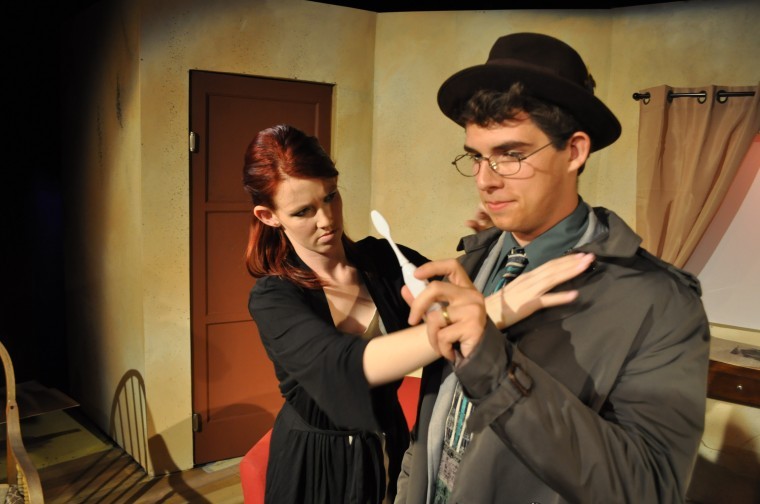
Photo Credit: Kevin Halladay-Glynn | The Los Angeles Loyolan

The art direction of a play can vary from something spectacular and opulent to a bare stage, but it’s rare that the stage itself is one of the most fascinating parts of a production. In “How the Other Half Loves,” the Del Rey Players’ newest show currently on stage in the Del Rey Theatre, the set is not only crucial, but it keeps the pace lively and stages the characters against each other in a unique and fascinating fashion.

While the staging is fantastic, the show is more than just its set. Hilarious, lived-in performances and a sharp pace make this show an impressive feat and a thrill to experience. Director Joe Hospodor, a junior theatre arts major, has achieved a trifecta of able direction, great set design and universally strong performances to create a portrait of domestic life that doesn’t sacrifice the humanity of its characters in search for a laugh.

The setup is simple enough: Two couples in the early ‘70s occupy opposite sides of the wealth spectrum. Frank and Fiona Foster (freshman theatre arts major Ben Szymanski and sophomore theatre arts major Paulina Fricke) are comfortable; Bob and Teresa Phillips (senior theatre arts and political science double major Rechard Francois and sophomore theatre arts major Mackenzie Ward) are less than wealthy. The primary conflict comes from Fiona and Bob’s off-stage affair and the troubles in the Phillips’ marriage.

From that central point, countless misunderstandings and awkward confrontations spur the action, and a third couple, William and Mary Detweiler (sophomore theatre arts major Kent Jenkins and senior theatre arts major Ashley Donnert) are thrown into the fray to further complicate matters. The play itself, written by playwright Alan Ayckbourn, is cute, but hinges so much on the characterization and the actors’ timing to sell the comedy.

On that front, the cast delivers in droves. This sextet of performances deserves a place in the (sadly non-existent) LMU Theatre Arts Hall of Fame – truly, this is an ensemble without weak points. As the Phillips, Francois and Ward strike the perfect balance of hate/love chemistry. Ward’s drunk and angry wife could have easily become unlikable and ventured into ‘shrill harpy’ territory, but she stays hilarious and never lets you forget that she’s truly the victim in the messy web of relationships.

Jenkins and Donnert should be given the greatest of ovations for their pitch-perfect performances as the Detweilers. From first entrance to the crucial dinner scene, where they have to essentially act in two scenes at once, the pair is flawless. Jenkins has appeared in several productions during his two years at LMU, but no director before Hospodor has harnessed his lovable, dork energy anywhere near as effectively. Donnert steals every scene she’s in, playing Mary as a meek mouse who always seems to want a way out of the crisis.

Fricke and Szymanski have arguably the hardest task of any of the actors: The Fosters are by far the most detached of any of the couples despite their picture-perfect marriage. Fiona is a particularly difficult character to make human amidst her seeming disregard for her husband and icy interactions with Teresa. However, Fricke succeeds at making her more than an alpha bitch. Szymanski is pulling nothing less than Herculean duty in selling the comedy of his character. Almost everything he does physically and with his voice when delivering a joke slays his audience. He has a gift for comedy, something Hospodor was incredibly smart to notice.

From start to finish, the production just runs like a well-oiled machine. The staging, with both main rooms on one set, allows for giant portions of the show to flow uninterrupted and keep the energy high. The costume design is clever and period appropriate, with the color choices of particular note. The lighting, while simple, does its job – there are a few dramatic moments that heighten the suspense thanks to a smart change in color or intensity.

The show isn’t perfect: The quick dialogue sometimes causes the actors to trip over their words. But the show is hardly hindered by its small flaws. In fact, it seems all the more real.

“How the Other Half Loves” is not an epic with massive sets and a veritable truckload of cast members, but it doesn’t need to be. It accomplishes so much with six skilled performers and a stage that pushes the storytelling into a new realm. Hospodor directs every aspect of the performance to the brink of perfection and often manages to push it there. It is a truly appealing production and a joy to watch.

Four showings of “How the Other Half Loves” remain this Wednesday through Saturday at 8 p.m. each night. Tickets can be bought through the Central Ticketing Agency.