Ryan Gosling and Emma Stone

A letter to Ryan Gosling, national treasure

Originally published in the Los Angeles Loyolan. For original, please refer to: A letter to Ryan Gosling, national treasure – Los Angeles Loyolan.

Ryan Gosling and Emma Stone

Photo Credit: Flickr Creative Commons

Dear Ryan Gosling,

I have a confession to make. As a major fan, it’s embarrassing for me to tell you, but I feel like being honest with you. After all, what’s a little awkward admission between imaginary friends like us?

Here’s the truth: I don’t like “The Notebook.” More than that, I don’t think you’re very good in it.

I know. As a fervent Gosling fanatic I should have been fanning myself over your heartthrob performance as Noah Calhoun. But I thought you were just OK. You had chemistry with your co-star and onetime girlfriend Rachel McAdams, yes, but it was definitely less than your best.

But that’s all in the past! You’re back now with incredible performances in movies such as “Drive” and “The Ides of March,” and you were smoldering and stellar in equal measure in “Crazy, Stupid, Love.” You’ve captured the hearts of the nation and the attention of critics who hold you up as the actor of your generation.

It’s so funny to think of you as the boy who was in the “Mickey Mouse Club” revival as a mouseketeer. You’ve risen above the exploits of your co-stars Christina Aguilera and Britney Spears, both of whom haven’t quite had the careers we expected. You’ve become a massive star in your own right, an A-lister who set Twitter aflame with the mere notice that you wouldn’t be attending the Golden Globes.

Personally, my love for you started with your performance in “Half Nelson.” Your only Oscar-nominated performance stands as one of your best – as drug addict and junior high teacher Dan Dunne, you were deeply affecting, with real gravitas and humanity. You only kept that roll going with “Lars and the Real Girl” as Lars Lindstrom, a man in love with a sex doll. In a role that could have been downright creepy in the wrong hands, you were charming and wonderful.

Unfortunately, a dark period soon fell upon us, and you waited for almost three years before gracing us with your on-screen presence once again. We were forced to rely upon a lesser Ryan (Reynolds, that is) to fuel our nation’s collective need for a heartthrob.

The drought ended when you gifted us with “Blue Valentine.” Your performance as Dean Periera felt lived-in and was truly arresting. Your chemistry with Michelle Williams was magnetic, both attracting and repelling. Your total willingness to commit to the role was impressive. I was smitten with your talent.

Then came the triple play of 2011. You turned America on as the suave ladykiller who is broken by Emma Stone in “Crazy, Stupid, Love.” You fit the role just as well as your suits fit you – perfectly. You followed it up with one of your most morally ambiguous roles – Stephen Meyers in “The Ides of March.” It’s not easy to make politics sexy, but you succeeded.

For me, the role that I’ll hold dear to my heart is your performance as Driver in “Drive.” An absolute knockout, you were especially impressive with sparse language and a towering presence. You sold the romance with Carey Mulligan and the violence against the gangsters with equal talent. Every movement was a well-choreographed dance of power. It sealed the deal – you clearly had the talent to fit the devastating movie star looks.

You’re so much more than your performances, too! You’re an Internet sensation with plenty of blogs dedicated to your image. You set the media world on fire when you broke up a street brawl and it was captured on video. You’re wanted by many, adored by most – what more could a man want?

You’re standing at the edge of your career – on one side, several devastatingly good performances; on the other, a future of success and fame. You’re destined to be not only a heartthrob, but a legendary actor, and I have no doubt that you can live up to your promise.

Let’s just agree to disagree on that performance in “The Notebook.”

Road to the Gold: The Best Picture nine

Originally posted as part of Road to the Gold, an Oscar blog on LALoyolan.com. For original, please refer to: The Best Picture nine – LALoyolan.com: Road To The Gold.

The Academy of Motion Picture Arts and Sciences (AMPAS) is a strange beast. It is like the Cerberus of awards-voting bodies: lots of heads with completely separate ideas but ultimately just one set of trophies to award. (Not that Cerberus handed out a lot of trophies – though I’m sure his ceremonies would have been a kick.)

With 6,000 voting members that include actors, directors, writers and editors, among others, it’s often impossible to figure out exactly how AMPAS will vote come Oscar-nomination time. Dozens of prognosticators online and in print attempt to predict exactly how AMPAS will act. This year, it seems as though Cerberus was just too confused, made some very strange decisions and prognosticators were thrown for a loop.

Throughout the Oscar season, I’ll be your guide through the various categories, doing my best to explain why certain nominees were given the nod, who will win in the high profile categories and fun facts behind the Oscars that you may not have known before.

For this inaugural post, let’s break down the Best Picture category. This year, a rule change in the Best Picture selection process allowed for anywhere between five and 10 nominees to be chosen – all dependent on how deep the films’ support was reflected in voting percentages. The new rule was created as a response to those who weren’t fond of the 10-nominee rule – which, in turn, was created when too many populist films were shut out of the race under the ancient five-nominee rule. Ultimately, nine films garnered a nod, and boy is it a strange group.

The greatest theme of this year’s Best Picture crop is nostalgia. Four of the nine films are specifically set in a long-past period, including the ‘30s (“The Artist”), World War II (“War Horse”), and the Civil Rights South (“The Help”). You’ve even got a film all about nostalgia and the double-edged nature of it in “Midnight in Paris.”

Other films among the nominees take on the big issues – be it the reinvention of how baseball was played in “Moneyball” or 9/11 in “Extremely Loud and Incredibly Close.” Terrence Malick even attempted to explain how the universe came into being in “The Tree of Life.”

The anomalies are the films that perhaps are best suited for the Best Picture race on paper: “The Descendants” and “Hugo.” Both movies were directed by revered filmmakers and set in desirable locales. The similarities stop there. “The Descendants” is a humanist comedy/drama hybrid with moral ambiguity. “Hugo” is a children’s film set in 3-D that serves as a cautionary tale about film preservation. Both films are passion projects, but both are also extremely different from their Best Picture compatriots.

While “The Artist,” “Hugo,” “Midnight in Paris,” “The Help,” “Moneyball” and “The Descendants” were long considered locks for nominations, Academy voters clearly let the waves of sentimentality wash over them when filling out their ballots. How else does one explain the inclusion of “War Horse,” a film that plays like a Steven Spielberg parody that Spielberg himself didn’t realize he was making? Or the inclusion of the emotionally manipulative “Extremely Loud and Incredibly Close,” which had little to no precursor award support?

The true anomaly, however, is “The Tree of Life,” a film beloved by critics. Most prognosticators (including one of the film’s producers!) thought the love wouldn’t carry over into the Academy, but both the movie and director Terrence Malick were recognized on nomination morning.

While several films had major critical support (including “Drive” and “Shame,” two films of which I am personally a massive fan), the two biggest snubs according to the precursors were “Bridesmaids” and “The Girl with the Dragon Tattoo,” both of which had massive support among the voting associations like the Producers Guild of America and the Screen Actors Guild. Both films also had major critical support, too, so their snubs were especially surprising.

While I can understand “Bridesmaids” not quite making it (while it was one of my favorite films, it just doesn’t seem like a traditional Academy movie), passing up “Dragon Tattoo” is especially bizarre, considering the “Girl” herself, Rooney Mara, was nominated for Best Actress. Then again, these are the same voters who rewarded stodgy, traditional fare like “The King’s Speech” over daring auteur-driven work like “The Social Network,” “Black Swan” and “The Fighter” last year, so maybe voters’ tastes are far more traditional than we’d assume (or hope).

As far as win potential, look no further than “The Artist.” It’s a silent film, it’s black-and-white, it’s incredibly well done with stellar performances, it’s French and it is genuinely entertaining. It’s a rarity that we should have a film that manages to be such a crowd-pleaser while also being truly marvelous.

It’s possible “Hugo” or “The Descendants” could surprise, but I wouldn’t put any stock in that idea. I think “The Artist” is the best film of the bunch and will win – despite those two things almost never occurring simultaneously. That in and of itself is enough to forgive a mediocre crop of Best Picture nominees – the end justifies the means.

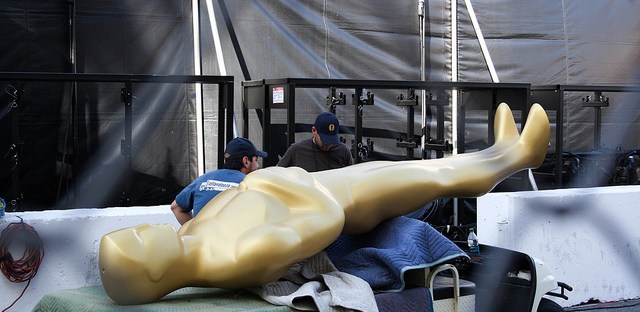
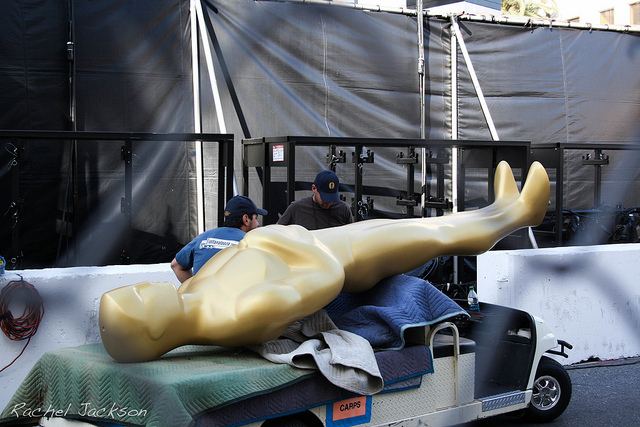
Oscar

Oscar nominations yield surprises and disappointments

Originally posted as part of Road to the Gold, an Oscar blog on LALoyolan.com. For original, please refer to: Oscar nominations yield surprises and disappointments – Los Angeles Loyolan.

Oscar

Photo Credit: Flickr Creative Commons

Every year, Academy Award prognosticators (those who attempt to predict the awards) eagerly await the morning of the nominations and what surprises they might bring. For the past years, surprises have not come. All the dark horse candidates remain at the fringe, and the usual suspects are nominated.

This year’s nominations, announced Tuesday morning, brought something different to the table. There were shocks aplenty and snubs across the board, from the craft categories all the way to Best Picture. Some front-runners were shut out of their races. It was Christmas morning for wannabe Oscar psychics, but for some, all that awaited them was a lump of coal.

Despite the strength of silent French film “The Artist,” Martin Scorsese’s 3-D epic “Hugo” actually led the overall nomination count thanks to its high tallies in the technical and craft categories. “Hugo” was nominated for Best Picture and Scorsese for Best Director, but it was shut out of the acting categories. “The Artist,” however, saw nominations in both Best Picture and Best Director and also won plaudits for stars Jean Dujardin in Best Actor and Bérénice Bejo in Best Supporting Actress.

There was much speculation coming into this year’s announcement of how many films would be nominated for Best Picture thanks to a new rule that permits anywhere between five and 10 films to be nominated based on voting percentages. Most severely underestimated the range of the new rule – while some predicted somewhere between six and eight films to be nominated, there were nine titles read, including critical darlings like “The Tree of Life” and traditional tearjerkers “War Horse” and “Extremely Loud and Incredibly Close.”

The acting categories were not without shocks. While frontrunners Brad Pitt for “Moneyball,” George Clooney for “The Descendants” and “The Artist” star Dujardin were included in the Best Actor field, Leonardo DiCaprio was not shortlisted for his impressive work in an otherwise mediocre movie, “J. Edgar.” In Best Actress, voters preferred “The Girl with the Dragon Tattoo” star Rooney Mara to precursor award favorite Tilda Swinton from “We Need to Talk About Kevin.”

The Best Supporting Actor race, which many Oscar prognosticators saw as a two-man race between Christopher Plummer for “Beginners” and Albert Brooks for “Drive,” got a little bit smaller today as Brooks was left out of the nominations altogether. It was only Best Supporting Actress that went exactly as most predicted, though some might consider “Bridesmaids” star Melissa McCarthy managing a nomination for such a broad comedy a massive shock in and of itself.

Personally, I always see the Oscar nominations as something of a game rather than an actual honor. The Academy so regularly snubs the films most worthy of nominations (it was heartbreaking to see Michael Fassbender and his film “Shame” snubbed, as well as the lack of recognition for Charlize Theron’s “Young Adult” performance), so it’s not worth sweating over what does and doesn’t make it.

Think, instead, of the strategy behind it all. Who are the phantom members behind the Academy and why do they vote the way they do? Will they stand by the classic directors like Steven Spielberg for “War Horse,” or will they be ambitious and nominate an up-and-coming auteur Nicolas Winding Refn for “Drive”? Ultimately, the awards don’t matter – they’re just fun to think about and follow, kind of like sports for the arts and entertainment nerd inside everyone. The show itself is always a blast, too – even at its worst, it’s certainly not the worst way you can spend a Sunday night.

So follow along this Oscar season and hear everyone bicker over what film deserves what honor. Fight for “Moneyball” if the Brad Pitt-starring baseball drama captured your imagination. Argue that Octavia Spencer was vastly better than Jessica Chastain in “The Help.” When all is said and done, you still have the movies you love and the actors you appreciate. No Academy can take that away from you.

The Oscars will air on Feb. 26th at 4 PM ET.